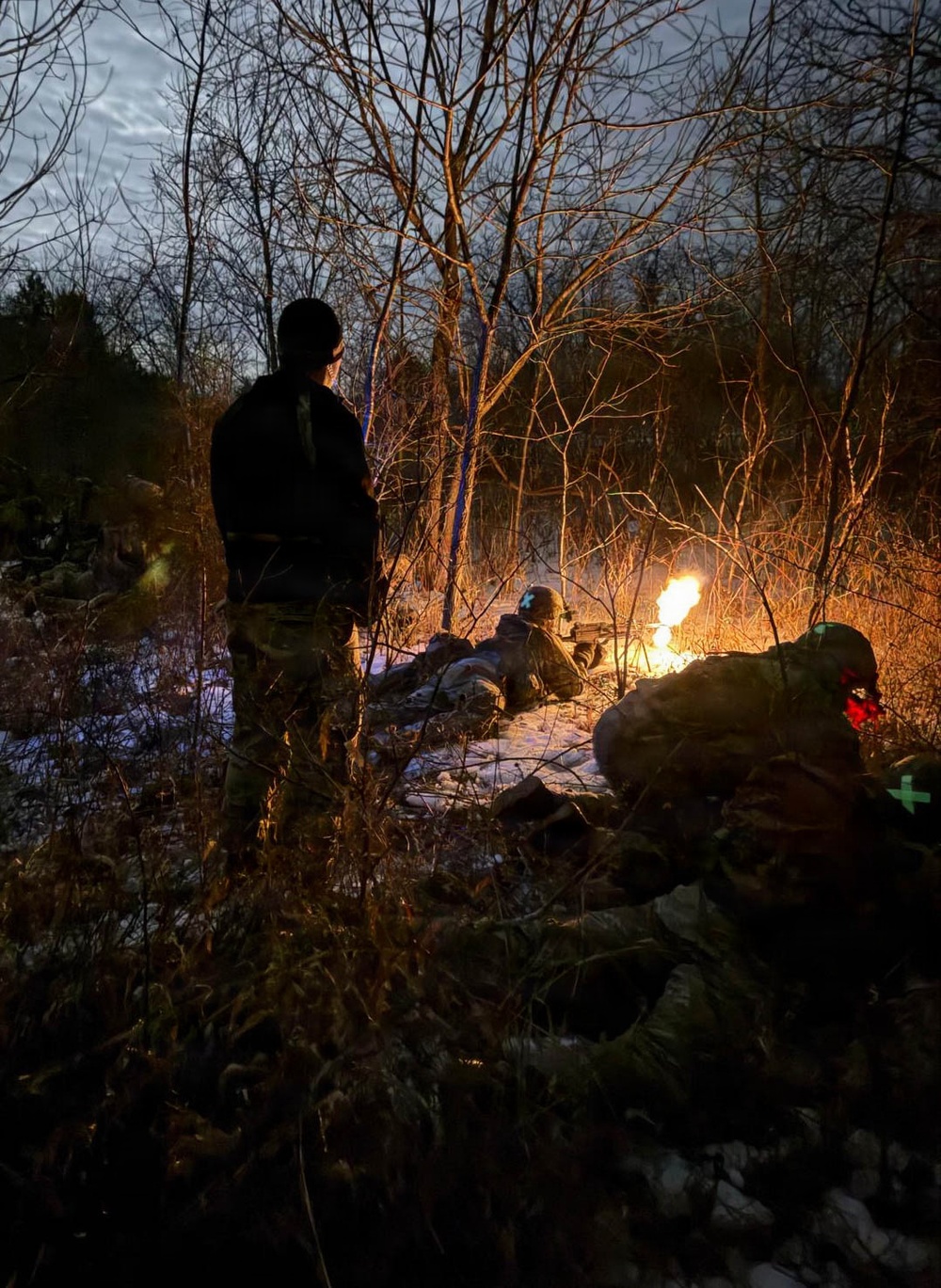
FORT LEONARD WOOD, Mo. — Of the four permanent individual skill tabs authorized for wear by the U.S. Army, one is earned exclusively at Fort Leonard Wood — the Sapper Tab.
The only way to earn the right to wear the Sapper Tab is by successfully completing the demanding 28-day [Sapper Leader Course](https://home.army.mil/wood/units-tenants/USAES/Sapper).
“The Sapper Leader Course is the U.S. Army Engineer Regiment’s premier leadership course, and the mission is to train and certify the next generation of Sapper leaders to serve as members of a combined arms team, through training combat engineer tasks, battle drills and missions in a physically demanding, stressful and austere environment,” said 1st Lt. Aron Carrow, Sapper Training Company commander.
According to Carrow, the first Sapper Leader Course class graduated in June 1985 with 18 service members, and the Sapper Tab was authorized for permanent wear in 2004.
“Being able to wear the Sapper Tab is about embodying a commitment that goes far beyond the physical cloth itself. While the tab is a visible symbol of the hard work, dedication and grit it took to endure the grueling 28-day course, its true meaning is in the daily actions that follow,” Carrow said.
“It’s about understanding the tab’s real value lies in constantly improving, studying and solving the complex problems the Army throws my way.”
Carrow said for him personally, the Sapper Tab represents humility and knowing that he doesn’t have all the answers but does possess the expertise to know where to find them.
“Wearing this tab means being a perpetual student and a reliable problem-solver, continuing to earn the right long after attending the course,” Carrow added.
Lt. Col. Kevin Lawhon, 169th Eng. Bn. commander, describes Sappers as technical experts in mobility, counter-mobility and survivability.
“Beyond that, they are leaders who have been tested physically and mentally, and proven that they can endure lack of sleep, lack of food, long patrols and harsh conditions, and still accomplish their mission,” Lawhon said. “Sappers are the problem solvers that you call when things are really bad and quitting isn’t an option.”
The idea of Sappers being the U.S. Army Engineer Regiment's ultimate warfighters is a concept frequently emphasized by [retired Lt. Gen. Robert Flowers, in whose honor the Best Sapper Competition is named](https://www.army.mil/article/204194/the_naming_of_the_best_sapper_competition).
Flowers, the 50th Chief of Engineers and former Fort Leonard Wood commanding general, launched the initial campaign to get a Sapper Tab to recognize engineers.
“When our nation needs a tough job done, they call the Army. When our Army needs a tough job done, they call on the Sappers,” Flowers said.
Sapper Leader Course students are primarily from the 12 series military occupational specialties, including [12B Combat Engineer](https://www.goarmy.com/careers-and-jobs/mechanics-engineering/design-develop/12b-combat-engineer).
“However, those outside of the engineering field can submit a waiver to attend,” Sapper Training Company 1st Sgt. Kegan Wise said. “The training is designed for sergeants to captains, but high performing individuals outside of those ranks can submit a waiver to attend.”
The course, under the direction of the Sapper Training Company, 169th Engineer Battalion, 1st Engineer Brigade, is taught in two phases, general subjects and patrolling.
During the first two weeks, the general engineering subjects phase, Sapper students undergo training in engineer reconnaissance; mobility and counter-mobility; engagement area development; conventional and expedient demolitions; urban breaching; threat ordnance; land navigation; knots and rigging; mountaineering; water operations; and task force engineer capabilities, roles and responsibilities.
The 14-day patrolling phase focuses on basic patrolling techniques and battle drills, placing strong emphasis on troop-leading procedures.
It incorporates the technical skills learned in the previous phase into a tactical environment to include patrol organization and movement; fires; recon, raid and ambush; engineer tactical tasks; operation warning and fragmentary orders; militaryoperationsinurbanterrain; breaching tenants; troop leading procedures; and a field training exercise to reinforce the battle drills and specialized engineering techniques learned throughout the course.
“For the capstone FTX, we ask the students to apply everything they’ve learned in the course in the offense and the defense in a field environment, under stress,” Lawhon said.
“When we’re on the offense, Sappers enable maneuver formations to get to the fight and breach enemy defenses at a time and place of our choosing. In the defense, we shape the terrain so that friendly forces are in a position of advantage and we can dominate enemy forces from a position of protection.”
According to Lawhon, today’s course is focused on three lines of effort.
“First, we’re integrating more technology into the course. We’re bringing in the latest demolitions and obstacle technologies. We’re bringing in robots to help keep our Sappers out of the breach. We’re bringing in 3D printed components to our demolitions training to help us get the same blast effect with less explosives, which means our Soldiers are carrying less equipment,” Lawhon said. Second, he explained, is making sure Sappers can fight in “varied” environments.
“During the Global War on Terror, we conducted stability operations primarily near cities and population centers,” Lawhon said. “Large scale combat operations mean we need to be able to operate in urban areas, but we also need to be ready to fight in the mountains, rural areas and even in the subterranean environment.”
And third, he said the battalion is making sure Sappers can take what they learn from the course and apply it in armored, Stryker and mobile brigade combat teams.
To showcase Sapper capabilities, the U.S. Army Engineer Regiment is hosting the 19th Lt. Gen. Robert B. Flowers [Best Sapper Competition](https://home.army.mil/wood/units-tenants/USAES/Sapper/BSC) April 18 to 23.
According to Sgt. 1st Class Nathen Wooden, Sapper Training Company, the competition tests the competencies, capabilities, and grit of Sappers.
“This year's competition will be mentally and physically demanding. It will span across Fort Leonard Wood and the Mark Twain National Forest,” Wooden said.
The competition is scheduled to begin April 18 in Waynesville’s Roubidoux Park. Winners are set to be announced during an awards ceremony April 24 at Lincoln Hall Auditorium.
To learn more about the elite combat engineers, visit the [U.S. Army’s Sapper website](https://www.army.mil/sapper/). More information about the Sapper Leader Course may be found on this [Fort Leonard Wood page](https://home.army.mil/wood/units-tenants/USAES/Sapper).
| Date Taken: |
03.18.2026 |
| Date Posted: |
03.19.2026 12:00 |
| Story ID: |
560910 |
| Location: |
FORT LEONARD WOOD, MISSOURI, US |
| Web Views: |
115 |
| Downloads: |
0 |
PUBLIC DOMAIN

This work, Sapper Leader Course: forging elite combat-ready engineers since 1985, by Melissa Buckley, identified by DVIDS, must comply with the restrictions shown on https://www.dvidshub.net/about/copyright.