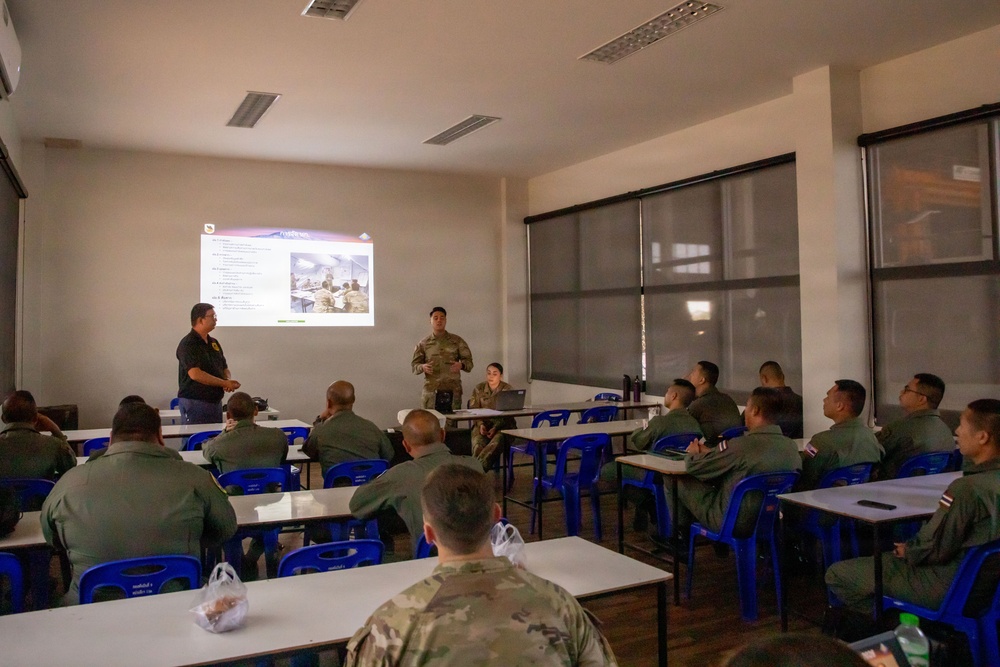
Photo By Staff Sgt. Jeremiah Woods | Washington Army National Guard aviators with the 96th Aviation Troop Command teach a class on battle operations for the Royal Thai Army aviators with the 9th Aviation Battalion during a subject matter expert exchange during Hanuman Guardian 26 at the Royal Thai Army Aviation Center in Lopburi, Thailand, March 13, 2026.
Hanuman Guardian is a bilateral training exercise between the U.S. Army and the Royal Thai Army in the Kingdom of Thailand. Now in its 17th year, the exercise enhances readiness through realistic training while reinforcing the enduring U.S.–Thailand alliance, one of America’s oldest partnerships, dating back to 1833, and a shared commitment to a free and open Indo-Pacific. (U.S. Army photo by Staff Sgt. Jeremiah Woods) see less
| View Image Page
Washington Army National Guard aviators share planning expertise with Royal Thai Army
LOPBURI, Thailand – Aviators from the Washington Army National Guard’s 96th Aviation Troop Command conducted classes for Royal Thai Army counterparts with the 9th Aviation Battalion during a subject matter expert exchange at the Royal Thai Army Aviation Center in Lopburi, Thailand, March 13, 2026.
Members of the 96th ATC staff conducted classes on command post operations, battle rhythms and battle drills used by the U.S. Army to plan and execute aviation missions. Training events like this improve interoperability between U.S. and Royal Thai Army aviation units by familiarizing both forces with the other’s planning processes and operational procedures.
The classes covered U.S. Army staff structure, the functions of each staff section, and how they communicate during operations. The instruction then focused on how battle rhythms support the planning process and improve operational efficiency. The exchange concluded with instruction on battle drills and how standardized procedures create a cohesive structure for conducting operations.
Staff Sgt. Fredy Mendiola, with the 96th ATC, was an instructor of the class. “A class like this is beneficial, because they don’t have the same operations that we do,” said Mendiola. “These classes give them ideas on how to operate on a bigger scale than what they’re currently working with.”
“Everything that the U.S. Army teaches us or recommends to us is going to become the SOP [standard operating procedure] moving forward,” said 2nd Lt. Ramet Jampasut, a Royal Thai Army UH-60 Black Hawk pilot with the 9th Aviation Battalion. “Some little detail we may have missed with the SOP, we see the gap, and we can fill it with information from these classes.”
Exchanges like these help the RTA refine standard operating procedures and improve operational efficiency. In aviation operations, streamlined planning and execution can directly impact mission success. Improving aviation mission planning helps ensure both forces are prepared to operate together during future exercises, contingency operations and humanitarian assistance or disaster response missions.
"We've identified there are certain things that we learned, that they haven't learned, that we were able to teach them,” said Maj. J.T. Bell, the operations officer for the 96th ATC and a UH-60 Black Hawk pilot.\_\_ \_\_“There’s a process to get them our products so that they can start using them and planning the same way that we plan.”
Thailand is one of the United States’ oldest treaty allies in the Indo-Pacific, and engagements like this strengthen the long-standing security partnership between the two nations.
Cpt. Nuttawut Pooklan, a Royal Thai Army UH-60 Black Hawk pilot with the 9th Aviation Battalion points out some of these benefits. “The highest benefit is in our ability to work together. When we have to work together, we don't have to orient ourselves to match. But we know the culture, we know how you do things. So it just works.”