
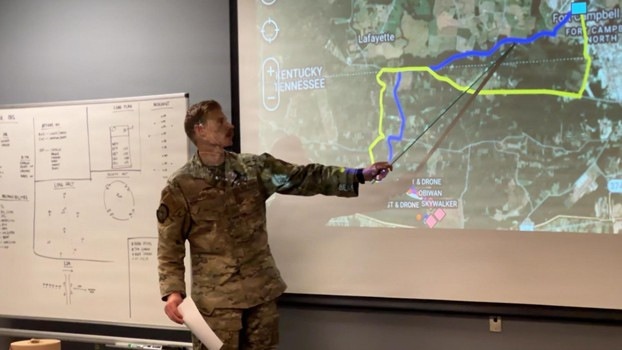
Photo By Jedhel Somera | A Tactical Air Control Party Airman with the 19th Air Support Operations Squadron...... read more read more
FORT CAMPBELL, Ky. — Air Force Tactical Air Control Party (TACP) operators from the 19th Air Support Operations Squadron (ASOS) underwent a comprehensive mission evaluation in January, utilizing advanced electronic warfare and drone technology to validate new ground combat standards.
The evaluation, which became a requirement for Air Force Special Warfare TACP units roughly two years ago, ensures operators maintain combat mission readiness through a full mission profile. The rigorous assessment covers every phase of a deployment, including preparation, infiltration, action on objectives, exfiltration, and a final mission debrief.
The evaluation began in a classroom setting where the team received a warning order detailing the mission. Lt Col Craig Lower, the 19 ASOS director of operations, served as the team leader during the exercise. He said the initial phase required the team to analyze the overarching mission set and discuss the scheme of maneuver while identifying the expectations for both friendly and enemy forces.
Once the planning phase concluded and a written portion was completed, the team moved to the field for a target acquisition mission. Evaluators provided only a rough area of interest, forcing the team to rely on specialized equipment to pinpoint an enemy location on an airfield.
The insertion took place in total darkness, requiring every operator to utilize night vision goggles. 1st Lt. Michael Morin, a ground evaluator assigned to the 19 ASOS, said the lack of ambient light made the mission particularly difficult.
Upon reaching the vicinity of the objective rally point, the team secured the area. While the assistant team leader maintained security, the team launched small unmanned aerial systems (sUAS) to obtain a visual on their objective.
The sUAS allowed the team to navigate the forest and locate targets in a large open area. This provided the commander with a live video feed to refine the targeting data.
The team also utilized Electromagnetic Spectrum Operations (EMSO), demonstrating their ability to sense, understand, and maneuver within the electromagnetic environment. Morin described the capability as enhancing visibility of spectrum activity and providing valuable context about its origins.
The integration of sUAS and EMSO capabilities highlights the importance of multi-domain awareness for forward elements. Lower said the team made its way through multiple checkpoints before reaching the objective area. By using the technology to refine their targeting, they were able to send reconnaissance and surveillance teams forward to pinpoint high-priority targets. This allowed the team to successfully coordinate simulated airstrikes and artillery strikes.
The introduction of these ground evaluations reflects a shift in how the Air Force tests its special warfare operators. Morin noted that because these evaluations are relatively new, units are still refining the process to ensure operators are tested to the highest of their abilities.
The integration of low-profile, high-powered technology and sensing capabilities are essential for the TACP community as it prepares for near-peer conflicts where the electromagnetic spectrum is a primary battlefield.
| Date Taken: | 02.20.2026 |
| Date Posted: | 03.13.2026 16:10 |
| Story ID: | 560531 |
| Location: | US |
| Web Views: | 490 |
| Downloads: | 5 |

This work, Modernizing Air Force TACP Ground Evaluations, by Jedhel Somera, identified by DVIDS, must comply with the restrictions shown on https://www.dvidshub.net/about/copyright.


No keywords found.





