
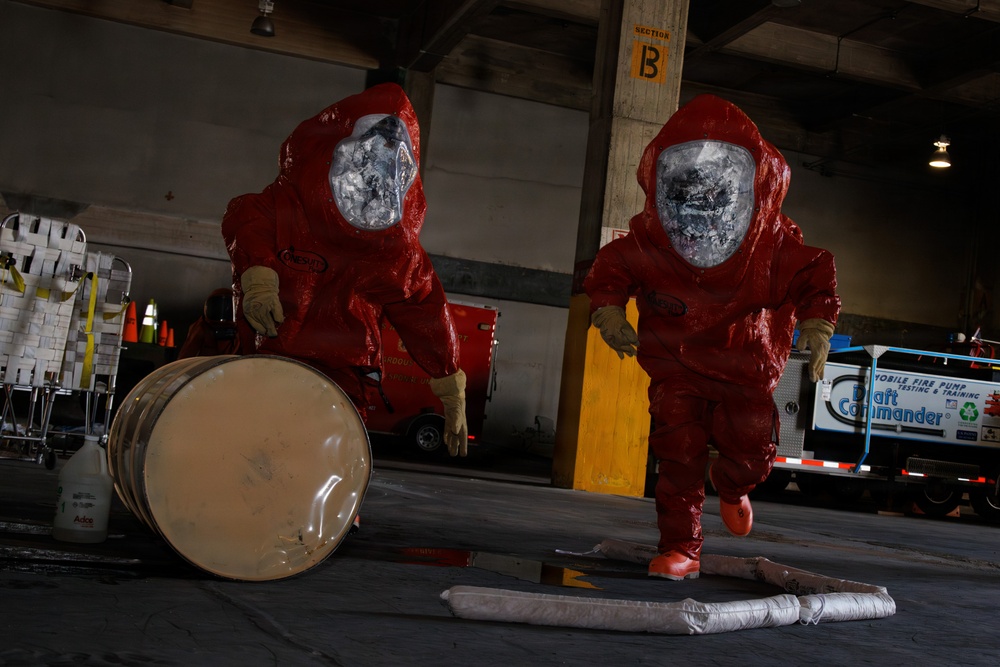
Photo By Lance Cpl. Dulce Alvarez Lemus | Firefighters, assigned to Marine Corps Installations Pacific Fire and Emergency...... read more read more
 Subscribe
CAMP KINSER, Japan (Feb. 26, 2026) – At 7:30 a.m., the shuffling of boots, alarms being tested and the chatter of morning checks signify a shift change at Camp Kinser Fire Station. For firefighters assigned to Marine Corps Installations Pacific Fire and Emergency Services, emergencies are a part of daily operations. “A normal day looks ‘peaceful’, but you know chaos happens, so that’s why we train every day.” says Masakazu Yara, South District Battalion Chief, MCIPAC F&ES. “We receive a lot of calls for car accidents, sick people and things of that nature.” At 8:20 a.m., before morning meeting began, MCIPAC firefighters responded to a sprinkler alarm on Camp Kinser. The activated sprinkler led to half a floor being flooded before firefighters responded to the call. The sprinkler was manually disabled at 8:54 a.m. by a group of three firefighters. By 9:32 a.m. the firefighters returned to Kinser Station and resumed standby operations. At 10:38 a.m., a U.S. Marine motor technician crushed his right index finger while removing his hand from a winch, a mechanical device used to adjust tension on a wire rope or cable. Zoie Huston, an emergency medical technician, responded to the incident at Kinser Motor Pool and treated the injury. “My first thoughts were to get the glove off, stabilize the bleeding and transport him to paramedics,” says Huston “After receiving treatment, the Marine ended up keeping his finger.” While awaiting their next call, firefighters prepare for a bilateral hazardous material exercise following a brief led by Yara. After the brief, crews staged their gear and equipment required to respond safely and efficiently to a HAZMAT incident. On Feb. 26, MCIPAC F&ES conducted a bilateral HAZMAT exercise with the Naha Fire Department and U.S. Army Garrison Okinawa Fire and Emergency Services. This marks the first bilateral HAZMAT training event involving all three departments. “The USAG F&ES responded first, then they realize they are over their capabilities. So, they request local firefighters and MCIPAC firefighters,” says Yara. “We join them and figure out how to mitigate the HAZMAT.” The exercise took place at Naha Port with a simulated trichloroethylene spill in a warehouse. USAG F&ES responded as the initial agency. Each department established decontamination sites and coordinated efforts to contain and mitigate the hazardous spill, with MCIPAC F&ES taking lead. A plan to evacuate seven simulated casualties and neutralize the spill was executed. “We work with different companies, different organizations, so the communication codes are very different,” says Yara. “Same for the tools as well, which is why at least every six months, we need to do this kind of thing.” Masks off and equipment put away, all three departments conducted a post-exercise discussion to evaluate performances and identify areas for improvement; specifically for potential emergencies at Naha Port. “I think this a great opportunity to learn from each other,” says Yara. “Cross training is very important because we don’t know when a situation like this will happen. So we need to know their capabilities and see each other face-to-face.”
- 30 -
| Date Taken: | 02.25.2026 |
| Date Posted: | 03.04.2026 00:16 |
| Story ID: | 559329 |
| Location: | OKINAWA, JP |
| Web Views: | 79 |
| Downloads: | 0 |

This work, MCIPAC F&ES host a bilateral HAZMAT exercise with USAG F&ES and Naha FD, by LCpl Dulce Alvarez Lemus, identified by DVIDS, must comply with the restrictions shown on https://www.dvidshub.net/about/copyright.


No keywords found.




