
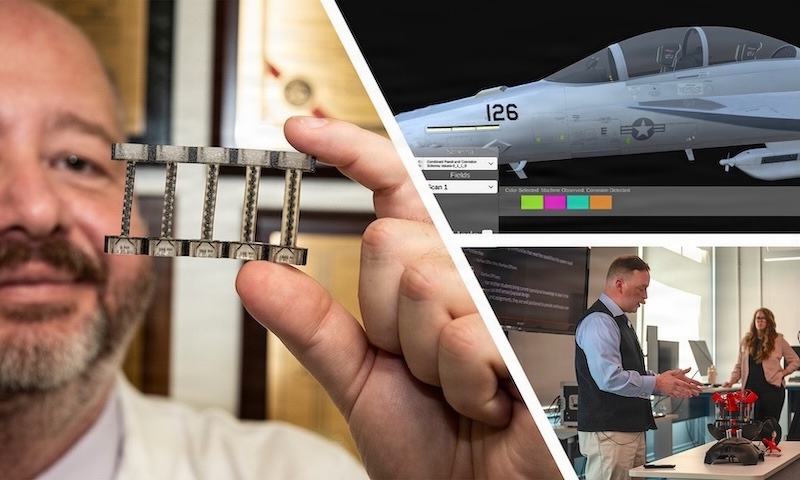
Photo By Javier Chagoya | MONTEREY, Calif. (Jan. 15, 2026). Education is the foundation of innovation. As a hub...... read more read more
 Subscribe
In an era increasingly defined by technology-driven competition, accelerating innovation cycles, and the demand for rapid application, the Naval Postgraduate School (NPS) remains a vital hub for turning ideas into impact. Many of those ideas reach the fleet — and some earn the distinction of a U.S. patent.
Marked by a growing portfolio of patents awarded to faculty, students, and research teams, NPS transforms cutting-edge concepts into operationally relevant capabilities that directly shape naval superiority and joint force effectiveness. NPS’ patent portfolio surpassed 200 last year, with inventions spanning a wide range of technical and tactical applications: novel explosive containment systems; non-GPS geo-positioning methods; advanced manufacturing processes; an ion thruster for use aboard small satellites; autonomous systems; computing and artificial intelligence applications; and even artificial muscles.
At NPS, graduate education and applied research are not parallel lanes; they are two sides of the same innovation coin, reinforcing one another, and together, generating innovative solutions to operational problems. Patents are one visible measure of that ecosystem, and they serve a practical purpose by protecting inventions and enabling clearer pathways to technology transition, licensing, and real-world use.
“Education at NPS fuels defense and warfighting innovation and capability,” said NPS president, retired U.S. Navy Vice Adm. Ann Rondeau. “These patents are more than technical achievements; they are solutions to real-world challenges, aimed squarely at strengthening warfighting advantage. Through learning, research, mission-driven invention, and relentless curiosity, we’re helping to develop the future force — and the warriors educated to lead it.”
A Legacy of Applied Invention
NPS patent records extend back to the early 1970s beginning with an electrogasdynamic spectral anemometer awarded in 1973. Designed to measure turbulent fluid streams and characterize turbulence intensity across multiple frequencies, the invention supported advances in both surface and undersea vessel design.
Recently NPS expanded its capability to help inventors. Of the twelve patents awarded in 2024, eight included NPS students as named inventors—a testament to the institution’s commitment to empowering warfighters as problem-solvers and innovators. That momentum remains strong. Eighteen patents were awarded in 2025, with 16 additional applications submitted.
The most recent patent, awarded in December 2025, focuses on virtual objects used to guide workflow and content creation in mixed and virtual reality environments, among other digital applications — a reflection of how the character of innovation has evolved alongside mission needs.
Those numbers reflect an essential truth about NPS: invention does not happen at the margins of graduate education. NPS students — mid-career military officers and Department of War (DOW) personnel — arrive with operational experience and a current perspective on mission challenges. They bring that operational insight directly into the research lab, ensuring ideas are driven by real needs and informed by emerging concepts of employment.
Operational Insight in Action
One such student, U.S. Navy Lt. Cmdr. Zishan Hameed, an engineering duty officer, arrived at NPS in 2017 with both a lifelong passion for nuclear physics and a growing awareness of the need for improved radiation detection devices.
The demand signal, he noted, was driven by heightened security concerns, expanded use of radiation in medical applications, and increased awareness among personnel working in radiation-exposed environments.
Current radiation detection methods are typically large, expensive, and difficult to maintain, making them impractical for widespread deployment. They also require accumulated radiation damage for detection and do not provide real-time, in situ awareness.
Working closely with NPS Department of Physics professor Dragoslav Grbovic and emeritus research professor Craig Smith, Hameed and fellow student, then Marine Corps Capt. John Gats developed a micro-sensor capable of “smelling” thermal neutron irradiation for their 2019 thesis. That work became the foundation for their patent, MEMS (micro-electromechanical systems) Nanotube Based Thermal Neutron Detector, granted in 2024.
“The patent is actually for the sensor itself, which uses a combination of boron nitride nanotubes and carbon nanotubes that detect a change in resistance caused by neutrons acting on the sensor,” Hameed explained. “It essentially functions passively like a nose — only instead of detecting various molecules, you’re detecting neutrons.”
The resulting sensor is low cost, low power, compact, reliable, and versatile, with potential applications spanning space operations, homeland security, and distributed sensor networks.
“One application would be inspection environments — seaports, points of entry, or teams conducting inspections in specific areas,” he said. “Another would be integrating the sensor as part of a larger system of sensors.”
Hameed emphasized that the discovery was a team effort.
“John [Gats] and I definitely could not have done it without each other,” he said. “And our advisors were hugely instrumental in facilitating collaboration with Lawrence Livermore National Laboratory for radiation sources and NASA Ames Research Center, which was critical for producing the sensors.”
“Working with the NPS faculty and staff and our collaborating research partners was such an amazing experience that I’m in the process of applying for a Ph.D. to come back to NPS and return to science,” Hameed added. “It really was that impactful.”
From Thesis to Capability: The WIEVLE Story
As NPS’ patent portfolio grows, the institution is also expanding its capacity to connect inventions with partners who can help mature and transition them. One recent example emerged from the school’s first Reverse Pitch Industry Day, where inventors presented licensable technologies and their potential applications to external stakeholders.
Among the systems that generated follow-on interest were two autonomous technologies resulting from student-driven research: a unique counter-drone hijacker, and a distinctive autonomous underwater vehicle known as the Wreck Interior Exploration Vehicle (WIEVLE).
With the look of a large black soccer ball, WIEVLE is designed to operate in extreme undersea environments. It addresses a niche that traditional unmanned underwater vehicles often struggle to reach: tight, cluttered, low-visibility spaces such as shipwreck interiors, seabed infrastructure, and other confined maritime environments. Its 2024 patent, awarded to Ross Eldred, systems engineering faculty associate for research, describes a low-cost, tether-free, modular autonomous underwater vehicle optimized for survivability and persistence rather than speed or range.
“We have no issue with the torpedo shape of traditional unmanned or manned underwater vehicles — I just don’t want to compete with those systems with this platform,” Eldred said. “What I’m after is capability, persistence, and the ability to survive in environments that would jam up other vehicles.”
The concept originated with Eldred’s December 2015 NPS thesis, “Autonomous Underwater Vehicle Architecture Synthesis for Shipwreck Interior Exploration,” completed while he was on active duty. The work was inspired by a challenge to explore the wreck of the Soviet-era nuclear-powered submarine K-278 Komsomolets, which sank off the coast of Norway in 1989 and still lies roughly a mile deep with its reactor and two nuclear-armed torpedoes onboard.
“While conducting open-source research, I discovered there was a large crack in its titanium hull,” Eldred recalled. “I thought, what if we could get something through that opening? That question led me into a deep dive through the systems engineering process to tease out the requirements.”
After returning to NPS as a faculty member in 2018, Eldred continued developing the concept through applied research, securing early funding through the Consortium for Robotics and Unmanned Systems Education and Research (CRUSER). Working with student interns and systems engineering capstone teams, he translated the thesis concept into physical prototypes and explored how the vehicle’s modular architecture could support a range of defense-relevant mission sets.
“I began to think of the vehicle more as a modular, mission-configurable platform,” Eldred said, “one where you can tailor the payload based on what you want to accomplish.”
Further support from NPS’ Naval Research Program — funded by the Office of the Chief of Naval Operations (OPNAV) — enabled examination of operational use cases such as mine warfare and seabed-focused missions. The work has since expanded beyond campus through collaboration with the Naval Facilities Engineering and Expeditionary Warfare Center, helping move the system toward a minimum viable operational capability.
“That’s the crawl, walk, run,” Eldred said. “For the first time, I’ll have dedicated engineers who can help carry this across the finish line.”
In August, Eldred received a second WIEVLE-related patent for its anchoring mechanism, which enables deployment, repositioning, recovery, and communications. A third patent, focused on a trans-domain autonomous vehicle, is pending. In parallel, he is developing an in-house controller module and working with Navy partners and a commercial collaborator to mature the system for potential licensing and broader U.S. Department of War use.
Like many NPS patents, WIEVLE reflects a progression from need, to graduate research to applied experimentation — guided by operational insight, shaped by student involvement, and sustained by partnerships that help carry promising ideas toward real-world impact.
Innovation Is a Team Sport
Innovation at NPS rarely follows a lone-inventor model. Instead, it emerges from a collaborative research ecosystem that integrates faculty expertise, student operational insight, defense laboratories, warfare centers, and private-sector partners. Many patented NPS technologies grew out of joint efforts supported by organizations such as the Office of Naval Research (ONR) and the Naval Warfare Centers, helping ensure research is both technically rigorous and operationally relevant.
Patents, however, can sometimes obscure that reality. Awarded to individuals, they are often perceived as singular “eureka” moments. In practice, most meaningful inventions are iterative and team-based, built on prior research and sustained collaboration. At NPS, a patent is not a finish line, but a checkpoint along a longer innovation pathway — from problem identification to experimentation, protection, and eventual transition.
That pathway also depends on institutional expertise in intellectual property. While the office for the NPS Vice Provost of Research and Innovation oversees the patent process, filing a patent is a complex legal endeavor, and at NPS, skilled attorneys are integral members of the innovation team.
“The patent process is initiated by a submission from inventors to patent counsel in the Office of General Counsel,” explained Martin Carbajal, NPS patent counsel. “We review the submission and prepare a technical description of the novel aspects of the invention for the Invention Evaluation Board.”
The Invention Evaluation Board brings together key stakeholders, including the Vice Provost, the Technical Transfer Program, the Director of Emerging Technology, rotating subject-matter experts, and patent counsel. The board evaluates inventions based on novelty, mission relevance, and potential impact.
“If approved, patent counsel drafts the application using inventor interviews and technical materials and files it with the U.S. Patent and Trademark Office,” Carbajal said. “That process typically takes 18 months to two years.”
Even after a patent is granted, the work continues. Patents require maintenance fees to preserve exclusive rights, often for up to 20 years, until they are licensed, transitioned, or sunset. For federal employees, the government generally retains ownership, while inventors receive a share of royalties under federal guidelines, balancing public benefit with incentives for innovation.
Throughout this lifecycle, NPS legal and technology transfer professionals provide sustained support, helping translate technical creativity into protected intellectual property, and protected intellectual property into real-world options for the fleet.
As the Department of the Navy seeks to accelerate the development, production, and adoption of new capabilities, patents help clear legal and commercial pathways that enable transition. They are not the end goal, but a springboard helping move promising ideas from the research environment into the hands of Sailors and Marines.
Learning from Leading Faculty Patent Holders
Emil Kartalov, associate professor of physics and director of the Advanced Warfighter Technologies Laboratory at NPS, exemplifies that pathway. Recently awarded another patent — his tenth from NPS projects and 40th overall — Kartalov continues to push the boundaries of applied science. One of his five patents received in 2025, T-Channel Microfluidic Devices and 3D Printing Methods for Producing T-Channel Microfluidic Devices, advances state-of-the-art additive manufacturing.
“3D printing is revolutionizing manufacturing and rapid prototyping, but there are still many challenges to overcome,” Kartalov said. “One is the ability to build conductive wiring inside the 3D matrix of printed devices. Our patent addresses that challenge through a self-assembly method based on physical principles.”
Patents, he noted, are tightly integrated with NPS’ mission to advance operational effectiveness and technological leadership.
“Applied science produces inventions that lead to new technologies, applications, and devices,” Kartalov said. “Our students are involved throughout that process. Patents form a critical link in the chain that starts with an idea, evolves through research into an invention, and ends as a military capability.”
Retired U.S. Navy Lt. Cmdr. Clay Greunke followed a similar arc – from NPS student to faculty member, to entrepreneur. His Multimodal Procedural Guidance Content Creation And Conversion Methods and Systems marked his sixth patent, with additional patents pending in the human-machine interface systems for spatial data operations domain.
In 2022, Greunke left NPS to co-found Humana Machina, a company focused on helping organizations navigate the “fourth industrial revolution,” with emerging technologies such as gaussian splats, spatial knowledge capture, as well as artificial intelligence and machine learning increasingly dictating how humans interact with machines and one another. Alongside Chief Technology Officer Michael Guerrero, a longtime NPS researcher, Greunke is advancing next-generation documentation infrastructure with defense applications.
One target is corrosion, one of the Navy’s most persistent and costly readiness challenges.
“Corrosion costs the Department of Defense more than $20 billion annually,” Greunke said. “The core problem isn’t treatment, it’s that we don’t have the ability to track or measure corrosion effectively.”
Using a natural painting interface, Greunke’s system allows users, both human and AI, to “paint” a record of corrosion spots directly onto a 3D digital model of an aircraft, vehicle, or ship. The system instantly captures the data, adds spatially precise semantic context, and auto-generates authoritative documentation that compresses the path from observation to action.
Greunke says utilizing this kind of technology would slash corrosion inspection and reporting times orders of magnitude over legacy methods, providing actionable, measurable data where before there was only a vague description.
Education as the Foundation of Innovation
NPS’ 200-plus patents represent more than isolated discoveries. They reflect a sustained institutional culture of exploring boundaries in pursuit of real-world solutions that strengthen naval sea power and intellectual overmatch.
Through focused curricula and degree programs in areas such as artificial intelligence, autonomy, and additive manufacturing, NPS immerses students in emerging technologies within a warfighting context. While some efforts result in patents, the broader payoff is leaders who think about warfighting in new ways, and who are equipped to lead solution development across the Fleet.
Patents are not the mission, but they reveal the mission in action: graduate education that produces warfighters with deep technical fluency; research shaped by operational insight; and invention that can be protected, partnered, and transitioned. In a strategic environment where advantage depends on both technology and the leaders prepared to employ it, NPS continues to deliver ideas to impact—one patent, and one problem-solving leader, at a time.
NPS, located in Monterey, California, provides defense-focused graduate education, including classified studies and interdisciplinary research, to advance the operational effectiveness, technological leadership, and warfighting advantage of the naval service. Established in 1909, NPS offers master’s and doctorate programs to Department of War military and civilians, along with international partners, to deliver transformative solutions and innovative leaders through advanced education and research.
(Does not constitute endorsement for non-federal entities mentioned.)
| Date Taken: | 01.16.2026 |
| Date Posted: | 01.23.2026 13:06 |
| Story ID: | 556644 |
| Location: | MONTEREY, CALIFORNIA, US |
| Web Views: | 185 |
| Downloads: | 0 |

This work, From Ideas to Impact: NPS Patents Power Defense Innovation, by Matthew Schehl, identified by DVIDS, must comply with the restrictions shown on https://www.dvidshub.net/about/copyright.


No keywords found.




