
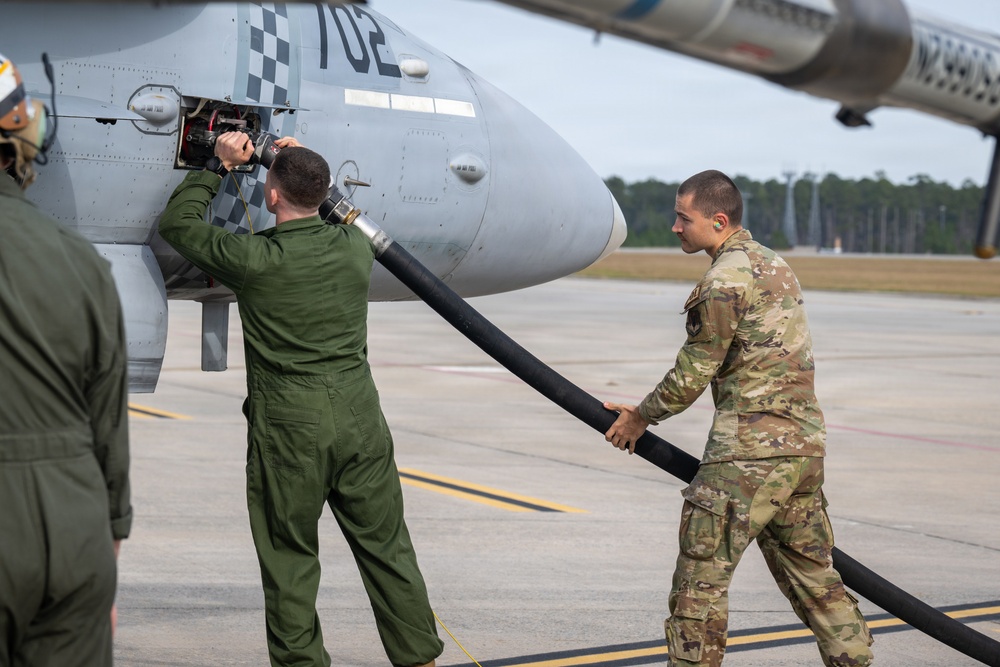
Photo By Senior Airman Iain Stanley | A U.S. Air Force Airmen assigned to the 23d Logistic Readiness Squadron and a U.S....... read more read more
 Subscribe
MOODY AIR FORCE BASE, Ga. — U.S. Air Force and Marine Corps units conducted a joint Combat Search and Rescue Training Exercise (CSARTE) at Moody Air Force Base, Georgia, Jan. 12–16, 2026, strengthening joint interoperability and refining the skills required to recover isolated personnel in contested environments.
Hosted by the 74th Fighter Squadron, CSARTE is a week-long exercise designed to create realistic combat search and rescue scenarios involving joint and combined forces. Participating units included the 74th Fighter Squadron, 41st Rescue Squadron and 71st Rescue Squadron, alongside Marine Corps aviation units Marine Fighter Attack Squadron (VMFA) 312 and VMFA-533.
The event evolved from a Republic of Korea–based combat search and rescue exercise originally focused on the A-10C Thunderbolt II, which is being phased out in that theater. As a result, the training was relocated to Moody AFB to continue developing combat search and rescue proficiency across a broader range of platforms and joint partners.
“CSARTE is about improving joint U.S. combat search and rescue lethality,” said Staff Sgt. Michael Ferraro, 347th Operations Support Squadron, Survival, Evasion, Resistance and Escape section noncommissioned officer in charge. “It sharpens pilot proficiency, refines joint planning and builds interoperability so these teams can operate together effectively in a real-world recovery.”
A key component of the exercise is the survivor role, which Ferraro emphasized as essential to meaningful training.
“The objective of combat search and rescue is the successful recovery of a survivor,” Ferraro said. “Without a real person on the ground acting as an isolated individual, the training loses its effectiveness and becomes just another sortie.”
By incorporating a live survivor, aircrews must communicate and coordinate with a person on the ground for aid, treatment and recovery, while simultaneously executing multiple mission sets. These include close air support, suppression and destruction of enemy air defenses, rescue escort, rescue combat air patrol, and authentication, location, threat and condition procedures.
While air operations typically focus on air-to-air and air-to-ground threats, the survivor perspective introduces a different challenge. “On the ground, a survivor’s focus is to maintain life, maintain honor and ultimately return with honor,” Ferraro said. “That’s a significant shift from typical air operations.”
Survivors must manage health and welfare, personal protection, communication, navigation and sustenance while evading enemy forces. They also rely on resistance tactics, techniques and procedures learned during SERE training to endure until recovery forces can be employed.
Joint interoperability was a central theme throughout the exercise, which integrated Air Force combat search and rescue assets with Marine Corps aviation units from Marine Corps Air Station Beaufort, South Carolina.
Maj. Patrick Ewald, VMFA-312 F/A-18 pilot, said the training strengthened integration between services.
“The purpose of training with Moody is to get better integration between the Marine Corps and Air Force units,” Ewald said. “We’re combining Marine Corps and Air Force assets to execute combat search and rescue missions, as well as strike missions, and using each squadron for what they do best within a larger force exercise.”
The joint environment extended beyond flight operations to maintenance and logistics, where service members adapted to unfamiliar equipment and processes to keep aircraft mission ready.
Lance Cpl. Jonathan Wilfong, VMFA-312 airframes mechanic, said working alongside Air Force maintainers highlighted the importance of flexibility and teamwork, particularly when using different ground support equipment.
“Working with the Air Force is a big thing because they have different ground support equipment than we do,” the Marine said. “Getting GSE out here can be tricky, but they really pulled through and helped us out.”
Ground support equipment, or GSE, includes tools such as nitrogen carts and generators used to service aircraft systems, including landing gear struts and auxiliary power units. Differences in equipment design required close coordination between maintainers from both services.
“They had rechargeable nitrogen carts that pull nitrogen from the air, while we’re used to using large nitrogen bottles,” the Marine said. “We couldn’t work that thing to save our lives at first, but they helped us through it. The logistics aspect was solid.”
According to Ferraro, this type of cross-service integration is essential to real-world recovery operations, where a single service may not have immediate access to all required assets.
“Joint interoperability is critical because it allows us to integrate capabilities from across the Department of Defense, other government agencies and even international partners,” Ferraro said. “Exercises like CSARTE establish the relationships and procedures needed so a real-world recovery can happen without delay.”
Ewald said the exercise also tested joint tactics, techniques and procedures in a near-peer environment, enhancing readiness and lethality by combining subject matter experts from multiple platforms and services.
“We really appreciate Moody Air Force Base hosting us,” Ewald said. “We’re looking forward to a lot more integration in the future.”
Through unity of purpose, relentless joint training and operational focus, exercises like CSARTE ensure every sortie, launch and recovery effort contributes to real, measurable readiness to deter aggression, defend the homeland and decisively win when called upon.
| Date Taken: | 01.16.2026 |
| Date Posted: | 01.16.2026 14:32 |
| Story ID: | 556340 |
| Location: | MOODY AIR FORCE BASE, GEORGIA, US |
| Web Views: | 188 |
| Downloads: | 0 |

This work, Joint Combat Search and Rescue Exercise Strengthens Readiness at Moody AFB, by SrA Iain Stanley, identified by DVIDS, must comply with the restrictions shown on https://www.dvidshub.net/about/copyright.


No keywords found.




