
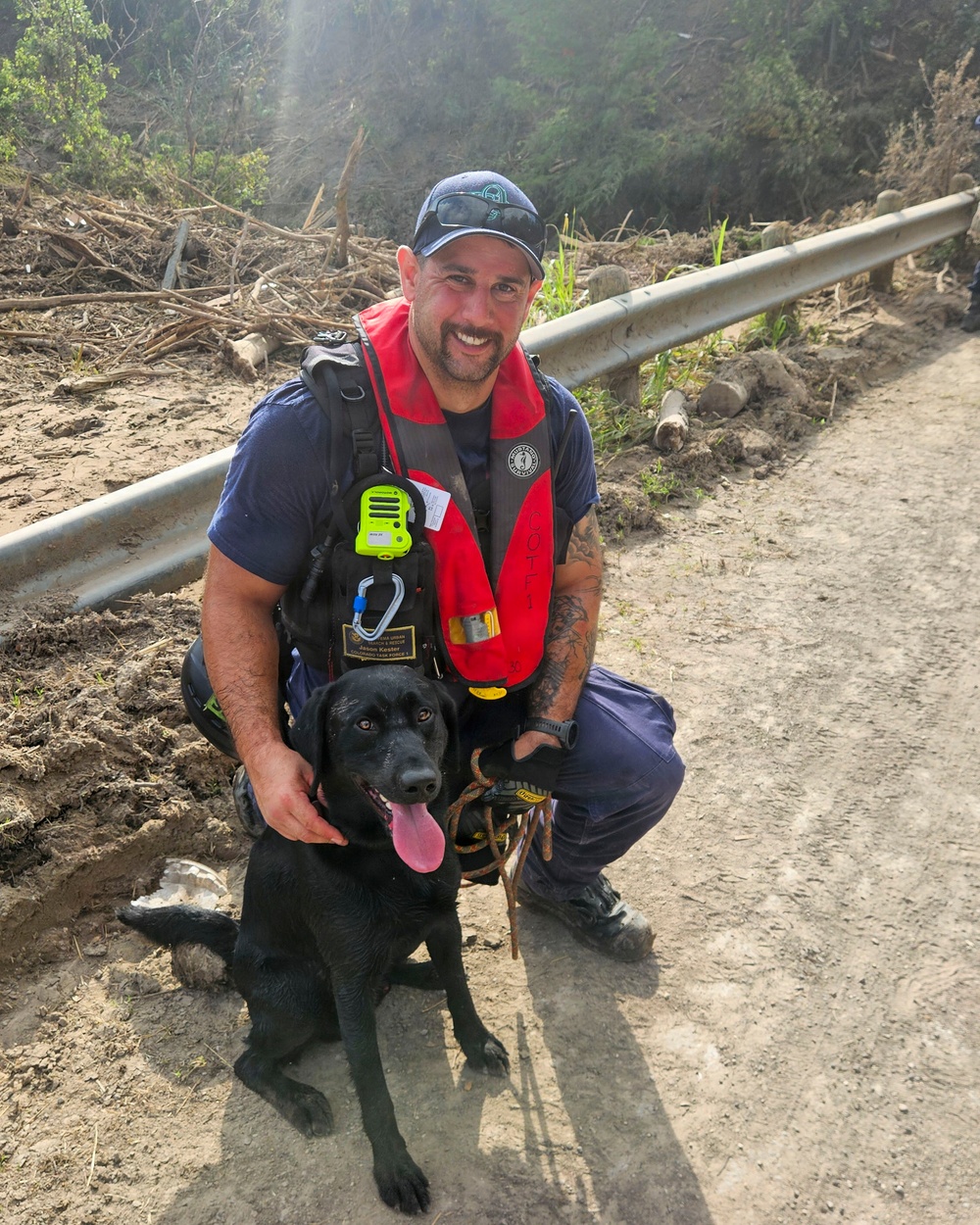
Photo By Tech. Sgt. Chance Johnson | U.S. Air Force Tech. Sgt. Jason Kester, a firefighter assigned to the 140th Civil...... read more read more
 Subscribe
While most of the U.S. was celebrating Independence Day with friends and family, the Guadalupe River was experiencing a devastating flash flood in Kerr County, Texas, July 4, 2025. The river rose over 20 feet in just a few hours, claiming the lives of more than 100 people and destroying countless homes in the process. The Citizen Airmen of the Colorado Air National Guard respond to the call to action, in or out of uniform, Colorado or nationwide. U.S. Air Force Tech. Sgt. Jason Kester, deputy fire chief, 140th Civil Engineering Squadron, embodied that sentiment when he deployed a K9 search-and-rescue system through his civilian occupation with Aurora Fire Rescue in support of search and recovery efforts for the Texas floods. As a lieutenant with AFR, Kester runs two dogs with the Federal Emergency Management Agency’s National Urban Search and Rescue Response System, Colorado Task Force One. The system responds to national incidents that exceed local resources, events such as the World Trade Center attacks, Hurricane Katrina, tornados, large wildfires, and other major disasters. “It was a pretty difficult search climate for all the reasons you can imagine: emotional, physical or otherwise,” Kester said about the Texas flood. “Mostly, there were so many children who had deceased from that event that got swept away with those camps.” When Kester and his team arrived, they were told there were still approximately 130 people missing, which ended up being far fewer once people were accounted for. Still, the operational period lasted about a month for the Colorado Task Force team. “For us, it was just showing the importance of what their community meant on the national level,” he said. “Because we're all looking for these families' kids and their brothers and sisters, et cetera. So, for them to see such a large response from the FEMA US&R side of things was probably the most rewarding because they knew we were there for the long haul.” “I specifically run my two dogs,” Kester said. “One of them is responsible for findingliving people, and then I have a human remains canine as well who finds the deceased. Training for that is anywhere between a few hours a week up to 20-30 hours a week. It really just depends on what you're trying to get out of the dog, what's coming up, and what's available.” On average, Kester trains with his dogs for 15-20 hours a week, much of which takes place at a rubble pile that simulates a collapsed structure near Denver International Airport. “The K9s have probably the highest level of training requirements within the system because the dogs always need to be working different things,” he said. “For example, in Texas, a lot of different variables were encountered down there: a lot of dead deer, a lot of dead animals, vehicles and boats, and lots of debris mixed with the water and the trees. It presented a different environment for them and a lot of different smells.” An additional aspect of training Kester is involved with is coordinating a joint services helicopter between FEMA and the Colorado Army National Guard. Many of the disaster areas where Kester’s canines might be needed may not be as easily nor quickly accessible from the ground. “We've been doing a lot of support, or getting a lot of support, by them allowing us to do familiarization with their helicopters, the Black Hawks specifically,” he said. “We'll go out and we'll do hot and cold loads, which gets the dogs familiar with what the helicopter looks like, what it feels like, and what it's like when it's running.” As a Guardsman, Kester’s “three-tiered experience” working at the local, state and federal level provides him the ability to “work with the fire department at the 140th, to deploy and be ready for whatever it is that they need us for,” he said. “It's all training in technical rescue and hazmat like rope rescue and slick water rescue.” Additionally, AFR has allowed Kester to run a program as a volunteer where he can put his dogs to use at a basic therapeutic level for other firefighters. “They're considered therapy dogs, but they're not technically certified at the therapy level yet; they're going to be introduced to the Aurora fire system to go out and preemptively meet with crews,” he said. The program gives firefighters a chance to have some downtime from the stresses of the job to relax and hang out with the dogs. After four years of trying to get the program up and running, Kester has three dogs who are currently getting certified. “We just did a visit about a week ago,” he said. “I don't have any training in therapy, but I'm a fireman just like them. So, the dog opens up avenues for them to vent or just talk about events.”
| Date Taken: | 01.14.2026 |
| Date Posted: | 01.14.2026 10:56 |
| Story ID: | 556199 |
| Location: | COLORADO, US |
| Web Views: | 78 |
| Downloads: | 0 |

This work, 140th Wing firefighter deploys K9 rescue team for Texas flood, by TSgt Chance Johnson, identified by DVIDS, must comply with the restrictions shown on https://www.dvidshub.net/about/copyright.

No keywords found.




