
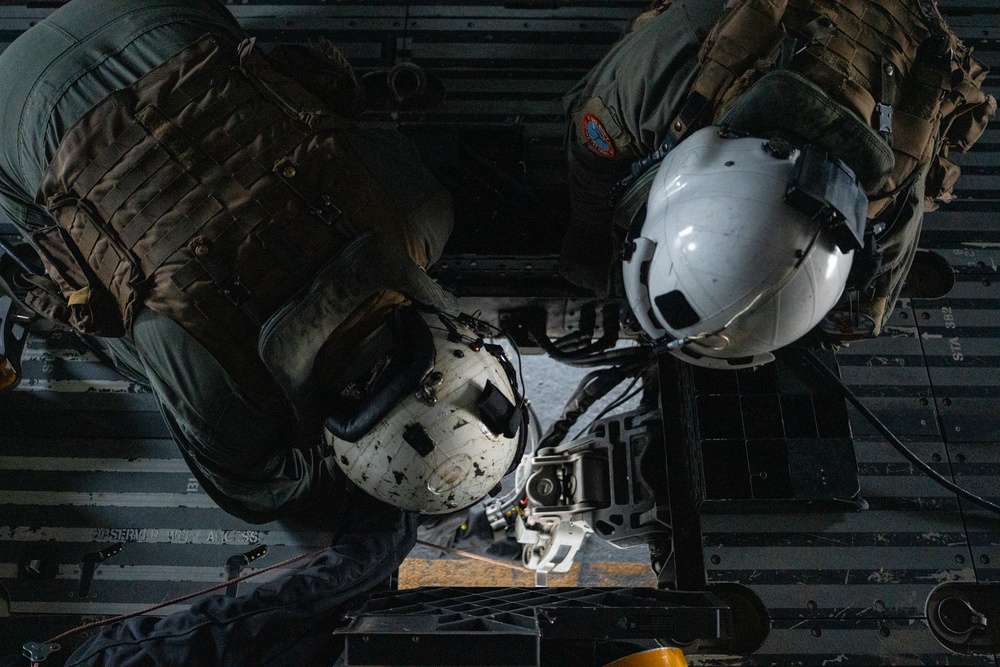
Photo By Staff Sgt. Maximiliano Rosas | U.S. Marines with Marine Heavy Helicopter Training Squadron (HMHT) 302, Marine...... read more read more
 Subscribe
MARINE CORPS AIR STATION NEW RIVER, N.C. – Forging a clear path for pilots and crew chiefs who are either fresh out of initial training or transitioning from the CH-53E Super Stallion, Marine Heavy Helicopter Training Squadron (HMHT) 302 trains Marines to become proficient and capable pilots and air crews for the Fleet Marine Forces.
“Primarily, the mission is to develop an aircrew” said Maj. Connor “Axe” Robertson, a Michigan native and a CH-53K King Stallion pilot instructor with HMHT-302. “The ideal goal is to send a proficient crew member that is able and ready to be a co-pilot [or crew chief] in the fleet.”
HMHT-302's core mission is to teach the fundamentals of assault support heavy lift. The HMHT-302 training cadre ensures students are focused on Naval Air Training and Operating Procedures Standardization procedures, a vital line of effort necessary to reinforce a culture of safety and readiness into the trainees. Students also train in basic flight maneuvers utilizing the CH-53K's modernized fly-by-wire systems, which enhances aircraft performance and eases pilot workload by helping to stabilize their aircraft in flight or while hovering. HMHT-302's training syllabus aims to continue the development of pilots and crew chiefs, continually reinforcing brilliance in the basics while emphasizing crew resource management. Ultimately this training prepares the student pilots and crew chiefs to operate with proficiency in a fleet unit.
Students at HMHT-302 run through a roughly six-month curriculum honing their skills on the rudimentary aircraft systems as well as maneuvering the aircraft. While at HMHT-302, they are run through the gamut of a detailed course curriculum and accumulate over 50 additional flight hours. The syllabus they adhere to serves as either a refresher to those transitioning from the CH-53E, or as indoctrination for new Marine Corps pilots.
“In flight school, they fly a much smaller aircraft than what they’ll strap into here,” said Robertson. “We are kind of the middle ground between flight school and the fleet. We try to give them an opportunity to grow.”
As the Marine Corps undergoes its heavy lift helicopter transition from the CH-53E Super Stallion to the CH-53K King Stallion, HMHT-302 will continue to play a critical role in developing pilots and crew chiefs as the Marine Corps’ sole fleet replacement squadron for the CH-53 platform. The CH-53K is designed to carry 27,000 pounds at a mission radius of 110 nautical miles which is almost triple the baseline of the CH-53E under certain conditions. The aircraft's “Glass Cockpit” upgrades to its digital systems improve visibility and user interface for they pilots who fly it. The King Stallion provides the Marine Corps with a vast leap forward in assault support capability, but doing so requires the dedicated training and expertise provided by HMHT-302's instructor cadre.
As one of the squadrons responsible for training the next generation of Marine aviators, every flight at HMHT-302 involves a balance of innovation, readiness, and risk mitigation. “What we do is inherently risky, you don’t just strap people into a warfighting machine and say there is no risk,” said Robertson.
That reality drives HMHT-302 to approach every evolution with deliberate planning, disciplined execution, and constant evaluation. In doing so, both instructors and students at HMHT-302 apply sound risk management principles and use common sense to mitigate unacceptable risk before and during every flight. “There is a lot of learning that still has to be done once you get to the fleet. Your focus shouldn’t be how good you are at 302 to just check the box. Learn your craft and be prepared.”
| Date Taken: | 12.29.2025 |
| Date Posted: | 01.27.2026 11:24 |
| Story ID: | 555930 |
| Location: | NEW RIVER, NORTH CAROLINA, US |
| Web Views: | 269 |
| Downloads: | 1 |

This work, HMHT-302 trains the future of Marine Corps heavy-lift aviation, by SSgt Maximiliano Rosas, identified by DVIDS, must comply with the restrictions shown on https://www.dvidshub.net/about/copyright.


No keywords found.




