
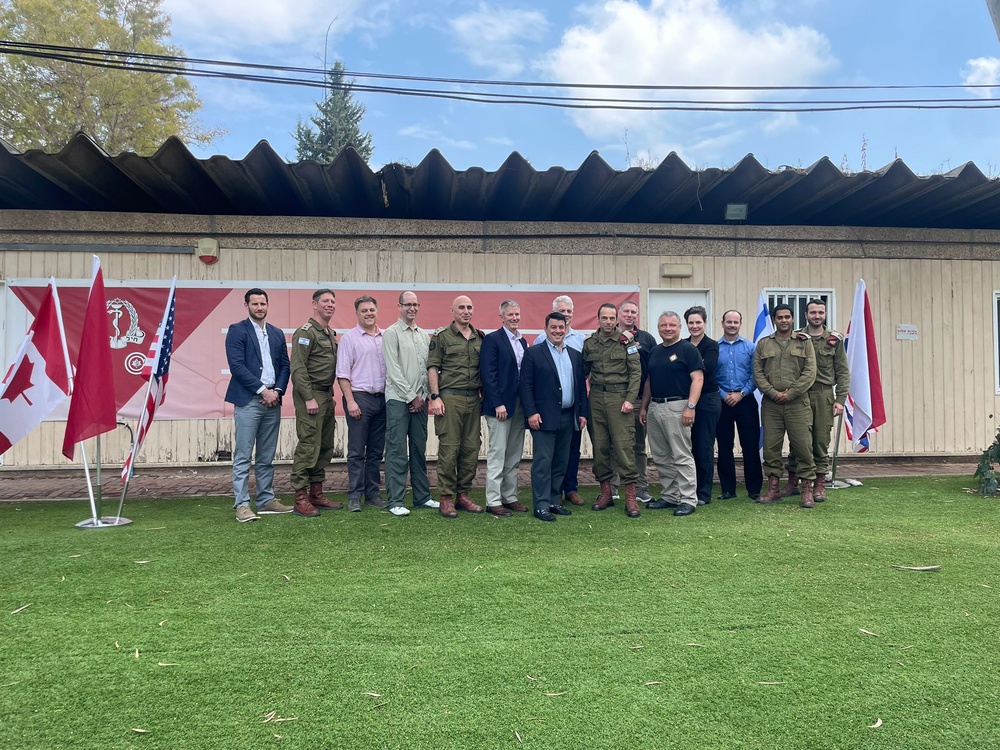
Courtesy Photo | A multinational team of trauma experts from the Trauma Hemostasis Oxygenation Research...... read more read more
 Subscribe
TEL AVIV, Israel – Six months after the devastating October 7, 2023, Hamas terrorist attacks, a multinational team of trauma experts from the Trauma Hemostasis Oxygenation Research Network (THOR) traveled to Israel to meet with the Israel Defense Force (IDF) Surgeon General and medical leadership to review how the IDF had been using blood products far forward in the treatment of casualties.
Lt. Col. Kevin R. Ward, a U.S. Army Reserve emergency physician and one of THOR’s leaders who has been at the forefront of forward blood use, traveled to Israel as a member of the small contingent.
“THOR is an international group that’s focused on best practices in remote damage control surgery, which is what we provide to injured casualties as close to the point of injury as possible. This was an exchange of information, to get a better understanding of practices, what we can add or recommend to it, as well as what we can learn and take back for our own U.S. casualty care operations,” said Ward.
Ward is currently assigned as an emergency physician with the 948th Forward Resuscitative Surgical Detachment, 807th Theater Medical Command, in Michigan. In his civilian capacity, Ward serves as Professor of Emergency Medicine at the University of Michigan, where he is Executive Director of the Max Harry Weil Institute for Critical Care Research and Innovation, one of the country’s largest multidisciplinary critical care research enterprises. He is also an Adjunct Professor Military and Emergency Medicine in the F. Edward Hebert School of Medicine at the Uniformed Services University of the Health Sciences.
A Career Bridging Medicine and Innovation
Ward’s career as a subject matter expert in far forward damage control resuscitation uniquely positioned him for this kind of collaboration as part of the THOR delegation. After earning his undergraduate degree in physiology from Louisiana State University (1985) and his medical degree from Tulane University (1989), he trained in Emergency Medicine at the University of Pittsburgh and completed a research fellowship at The Ohio State University. His academic path led him to faculty roles at Henry Ford Hospital in Detroit, Michigan, and the Medical College of Virginia at Virginia Commonwealth University before joining Michigan, where his work spans medicine, engineering, and innovation.
A biomedical innovator, Ward holds over 50 U.S. patents and has founded 10 companies. His research and inventions, ranging from predictive analytics to hemostatic dressings, have resulted in six FDA-approved products. Among his most notable contributions is the discovery of the hemostatic properties of clay, which helped lead to Combat Gauze, now a standard military battlefield dressing. He also assisted in the development of the Ranger O Low Titer (ROLO) blood transfusion protocol with the 75th Ranger Regiment (a walking blood bank allowing blood donation at or near the point of injury), co-authored the U.S. military’s Joint Trauma Services Damage Control Resuscitation guidelines, and trained more than 2,000 U.S. Special Operations combat medics through military-civilian partnerships.
Although Ward’s civilian research centered around combat casualty care, he still wanted to do more. Ward commissioned into the U.S. Army Reserve Medical Corps in 2019 at the age of 56 and deployed to Afghanistan in 2021 and Syria in 2025 in support of Operation Resolute Support and Operation Inherent Resolve.
Field Visits: Witnessing the Aftermath
The THOR delegation also included Col. Jennifer Gurney, Chief of the Defense Health Agency’s Joint Trauma System, and Capt. Travis Polk, U.S. Navy and former Director of the Combat Casualty Care Research Program for the Department of Defense Medical Research and Development Command, military trauma personnel from the United Kingdom and Canada, and clinicians and scientists from the U.S. The IDF Surgeon General, Brig. Gen. Elon Glassberg, a fellow THOR member, hosted the group April 8-10, 2024.
“It was a very intense three days on ground,” said Ward, as the team visited sites in the Gaza border region, including the grounds of the NOVA music festival massacre, an IDF armored unit marshaling yard to view the armored evacuation platforms, and the Re’im IDF post which sustained devastating losses.
The team also visited the IDF Military Medical Academy, which houses an innovative simulation facility focused on training medics and Advanced Life Support (ALS) providers, the country’s Home Front Command, and the Magen David Admon National Blood Bank one of the most sophisticated blood product collection, testing, and storage facilities in the world.
“We received a detailed briefing on the October 7 Hamas attacks, the challenges of responding to a surprise attack at scale, and the toll it has taken on their medical corps,” stated Ward.
The IDF evacuation process focuses on gaining access to casualties as far forward as possible by embedding ALS providers within each forward company. These ALS providers and medics travel in armored personnel carriers to collect and evacuate casualties, allowing casualties to receive blood products such as freeze-dried plasma and whole blood as soon as possible after wounding.
“Many casualties receive tourniquets and freeze-dried plasma in the field by medics, who all carry freeze dried plasma. Casualties then receive whole blood in armored personnel carriers by physicians or other ALS providers and are taken to evacuation points for flight to one of several Israeli civilian Level 1 trauma centers,” explained Ward.
With a battlespace that is its own country or in proximity, Israel faces a much different conflict than the U.S. and other allies, often depending on the integration of military and civilian medical assets through its Home Front Command. The IDF echelon-based care system resembles that of the U.S. Army, including care under fire, tactical field care, and tactical CASEVAC (casualty evacuation from a battalion aid station via ground or air transport). However, with no military hospitals in country, the IDF focuses on prehospital care and rapid evacuation of casualties to civilian Level 1 trauma centers (average time from point of injury to hospital being 66 minutes) for final definitive care.
The Home Front Command integrates military and civilian medical infrastructures to manage hospital bed capacity, blood supply, and evacuation coordination during crises. Using the link to the Home Front Command may mean challenging Israel’s whole healthcare structure, but it also maximizes efficiency.
“Israel’s military and medical care, along the various echelons of care after wounding, are so tightly integrated with their civilian infrastructure. Just because you’re at war doesn’t mean your civilians aren’t having car accidents, heart attacks, and strokes. They must manage civilian emergency cases while prioritizing civilian and IDF casualties from the war,” said Ward.
The rapid transport to civilian facilities and early transitions through specialized echelons of care while administering blood products have decreased the IDF’s mortality rate from 15% to 6.5% over the last 20 years, even as injury severity has increased.
“Having a physician or other ALS provider there is one thing but having access to a valuable resource like whole blood will really help extend that golden hour. We’ve learned alongside the IDF that the earlier you can get blood and blood products, especially whole blood, to an injured casualty, the better their chances for survival,” said Ward.
These blood products are distributed as needed to both the IDF front lines and civilian hospital trauma centers.
“As an emergency physician, my efforts and passion are to innovate and develop better ways to resuscitate complex casualties. What the IDF is doing with freeze-dried plasma and whole blood, which is difficult to do at scale, has a gratifying impact,” Ward reflected. “The U.S. has not gotten there yet, but that’s something we’re going to have to be able to do if and when we have a large-scale conflict.”
Ward also highlighted the IDF’s rapid development and implementation of an electronic casualty card and system, improving the transmission of critical injury and treatment data across military and civilian medical echelons of care.
“Documenting critical injuries and interventions in real-time during casualty care across echelons of care has historically been a significant challenge. Often casualties arrive to higher echelons of care with virtually no documentation such as vital signs, treatments, and responses to treatment. This makes the job of medical providers at higher echelons of care difficult,” explained Ward. “The IDF’s creation after October 7th of this robust and easy-to-use electronic casualty care system is a testament to the sheer will and ‘innovation-in-motion’ attitude of the IDF Medical Corps. In my opinion it will become a standard and greatly assist us in improving casualty care.”
Fast Forward to the Past
In World Wars I and II, complex battlefield casualties received whole blood and freeze-dried plasma for resuscitation, but after Vietnam, medical providers began to fractionate blood into red blood cells, plasma, and platelets due to infectious diseases and many civilian trauma patients only needing one of the components.
“We thought we could treat massive casualties with lots of crystalloid fluids, and we did this up until the early 90s. This caused a lot of complications and additional organ failure. It wasn’t until we were deep in the Global War on Terror with massive casualties from IED explosions and high velocity wounds that we started to move towards the early use of blood products,” said Ward.
As providers began reconstituting blood products (packed red cells, plasma, and platelets) to treat massive hemorrhage, this practice led them back to using whole blood to treat hemorrhaging combat trauma casualties.
“Data has shown that if you get blood within 30 minutes to an hour of your injury, your chances of survival go up astronomically. Whole blood has all the clotting factors (including platelets) as well as the oxygen carrying benefits of red cells, so getting whole blood earlier helps stop bleeding and restores oxygenation to vital organs,” said Ward.
While the U.S. has access to freeze-dried plasma for Special Operations forces, its supply currently comes from non-U.S. sources. Israel is really the first country since World War II to re-introduce and use freeze-dried plasma at scale during war, noted Ward.
“If nothing else changed in terms of tactics, I would like to see [the U.S.] continue to innovate and get blood products, especially whole blood and freeze-dried plasma in greater quantities as close to the point of injury as possible,” Ward continued.
While whole blood must be refrigerated, freeze-dried plasma does not require pristine storage conditions which allows it to be stockpiled for long periods of time. Unique options, however, are being explored to allow greater flexibility for whole blood delivery such as by drones in conditions where air and ground superiority are compromised. The goal is to keep military and civilian casualties alive with the most effective blood components until they can be evacuated to the appropriate echelon of care.
“You can’t be everywhere at one time, so it’s also teaching civilians to be as self-sufficient as possible until you can get experts there,” said Ward.
Shared Lessons and Future Cooperation
For Ward, who has spent his career blending clinical care with biomedical innovation, the trip underscored both the resilience of Israel’s people and the value of shared medical lessons across borders.
This is Israel’s longest conflict by far, stated Ward, which poses challenges to the IDF as it relies heavily on reservists and increases the strain on ALS providers.
Ward expressed he was particularly moved by the bravery and skill of the IDF’s 670 far-forward ALS providers, 40 of whom became casualties during the October 7 aftermath.
“These providers that have been injured and killed in action…that’s a testament to their warrior mentality and how they’re trained,” said Ward.
Ward and the team observed several other “less is more” strategy changes implemented by the IDF at scale that have previously been advocated by THOR. These practices focused on simplified treatment protocols including reduced reliance on airway interventions and eliminating needle decompression of the chest except for profound shock.
The THOR team made limited recommendations to the IDF given the potential need to extend operations in case of conflict escalation but encouraged adoption of systematic quality improvement processes modeled on the U.S. Joint Trauma System.
Ward also remarked that while the U.S. and Israel face different battlespace challenges, both nations share a common goal: ensuring that every possible life is saved through smarter, faster, and more effective combat casualty care.
Notes:
| Date Taken: | 01.07.2026 |
| Date Posted: | 01.08.2026 20:09 |
| Story ID: | 555890 |
| Location: | IL |
| Web Views: | 545 |
| Downloads: | 0 |

This work, U.S. Army Reserve Physician Joined International Team to Study and Advise on Israeli Defense Force Combat Casualty Care, by LTC Kristin Porter, identified by DVIDS, must comply with the restrictions shown on https://www.dvidshub.net/about/copyright.


No keywords found.




