
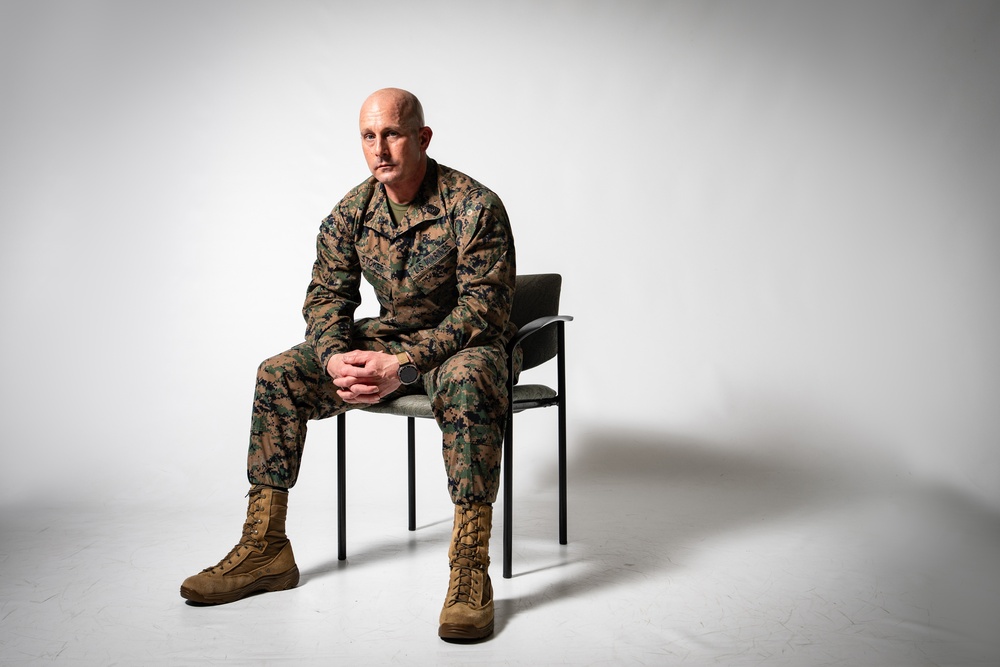
Photo By Staff Sgt. Scott Jenkins | U.S. Marine Corps Master Sgt. Joseph B. Stoker, 4th Marine Aircraft Wing, poses for a...... read more read more
 Subscribe
NEW ORLEANS – A new program offering a unique career transition for Marine Corps enlisted leaders has attracted attention, and a local Marine with U.S. Marine Corps Forces Reserve is one of the first to benefit from the program.
Master Sgt. Joseph B. Stoker has been selected and approved to transition to the rank of first sergeant in January 2026 as part of the new E-8 pilot redesignation initiative. Stoker has nearly 17 years of service to the Corps.
"I came into the Marine Corps from a place of uncertainty, but it gave me a chance to build a life and purpose I never thought possible,” said Stoker, “As I transition to First Sergeant, I’m determined to give back, leading Marines with the same integrity and dedication that was shown to me."
This program, established through Marine administrative message 346/25, allows qualified master sergeants to apply for the first sergeant military occupational specialty, opening new leadership opportunities for experienced Marines.
“The redesignation pilot marks a significant milestone in the Marine Corps, as this program is a newly established option that gives master sergeants greater control over their careers,” said Sgt. Maj. of the Marine Corps Carlos A. Ruiz. “It advances our talent management efforts by ensuring our E-8s are placed in positions that best support both their success, and that of the Marine Corps.”
The traditional pathway to either first sergeant or master sergeant in the Marine Corps starts at the rank of gunnery sergeant, where after serving as an E-7 Marines are formally selected to the rank of first sergeant or master sergeant respectively. Marines typically declare their intention to serve as one or the other; however, a formal board process makes the final determination.
A first sergeant serves as the senior enlisted leader at the company or battery level, responsible for the well-being, discipline and readiness of all enlisted Marines within their unit. They are the primary link between the commanding officer and the enlisted ranks, ensuring that the commander's policies are communicated and implemented effectively.
A master sergeant is a senior enlisted technical expert within their military occupational specialty. They serve as advisors and oversee daily operations, training, and standards within their field, ensuring Marines and missions are fully prepared and executed correctly.
Both ranks mentor enlisted Marines, provide experienced advice to officers and enforce accountability across the unit; however, the role of first sergeant is more centered on overall command leadership, welfare and unit cohesion.
This shift from master sergeant to first sergeant involves stepping into a role that emphasizes leadership and mentorship over technical proficiency, with a greater focus on the overall health and success of the unit and its Marines.
For Stoker, the decision to apply and ultimately be selected is rooted in a deep commitment to mentorship and the desire to have a greater impact on the Marines he leads.
“I’ve always believed that the strength of the Marine Corps is its people, and I want to be in a position where I can guide and mentor more Marines, on a larger scale, to become the leaders of tomorrow,” said Stoker. “This new opportunity allows me to further that goal. It’s about making a real difference in the lives of those I lead.”
Stoker’s career journey reflects his dedication to the Corps, having served in various high-profile roles, including as a drill instructor, senior enlisted advisor, and most recently, as the wing aircraft maintenance/material readiness chief with 4th Marine Aircraft Wing. His experience spans across numerous positions, from the frontlines in Afghanistan to supporting the commander-in-chief aboard Marine Helicopter Squadron One (HMX-1).
One of the key moments in Stoker’s career came when he served as a senior drill instructor where he witnessed firsthand the profound impact a senior enlisted leader could have on the development of young Marines.
“I saw Marines who had no idea of their potential, and I had the privilege of helping them realize it. That’s the type of leader I want to continue to be,” Stoker said. “As a first sergeant, I can reach even more Marines at a crucial point in their careers.”
The redesignation to a first sergeant is a significant step, as it involves not only leadership over larger groups of Marines but also more responsibility in advocating for their needs and ensuring overall good order and discipline. The E-8 redesignation program was designed to ensure that experienced leaders like Stoker could apply their skills to meet the evolving needs of the Marine Corps.
“I’ve seen the evolution of the Corps and its challenges, and I’m ready to help guide the next generation of Marines through them,” Stoker explained. “It’s not just about maintaining standards; it’s about empowering Marines to exceed them and make a lasting impact on their units.”
Stoker’s extensive background in both operational and instructional roles makes him uniquely qualified to step into a first sergeant role. His numerous awards, including three Navy and Marine Corps Commendation Medals and two Navy and Marine Corps Achievement Medals, further highlight his dedication to excellence. His leadership philosophy revolves around hard work, humility and a commitment to the Marines he leads.
“Master Sgt. Stoker was a first sergeant in all but rank. The chevron wasn’t a promotion, but a confirmation of the leader he has always been,” said Sgt. Maj. Edwin A. Mota, command senior enlisted leader of U.S. Marine Corps Forces Reserve and U.S. Marine Corps Forces, South.
As Stoker looks forward to pinning on first sergeant in January 2026, he is clear about his ultimate goal: to continue serving with pride and to set the example for the Marines of tomorrow.
“I’ve been given so much by the Marine Corps, it’s time for me to give back in a new way,” he said. “When given the opportunity to wear the diamond, I will do everything in my power to live up to the example set by those who wore it before me.”
With the E-8 redesignation pilot program initiated, Stoker’s selection is a key moment that highlights how the Corps is adapting to meet the needs of its future leaders.
“By next year, we are aiming to introduce a pilot program allowing first sergeants to apply for selection as master sergeants. The hope is to provide greater flexibility for E-8s, while continuing to place proven leaders where the Marine Corps needs them most,” stated Ruiz.
This opportunity ensures that the Marine Corps will continue to build strong, effective leaders who are prepared to guide their units in the years to come.
| Date Taken: | 12.30.2025 |
| Date Posted: | 12.31.2025 14:02 |
| Story ID: | 555460 |
| Location: | NEW ORLEANS, LOUISIANA, US |
| Web Views: | 146,007 |
| Downloads: | 1 |

This work, From Master Sergeant to First Sergeant: Master Sgt. Joseph B. Stoker Paves the Way for Future Leadership in the Marine Corps, by SSgt Ethan LeBlanc, identified by DVIDS, must comply with the restrictions shown on https://www.dvidshub.net/about/copyright.


No keywords found.




