
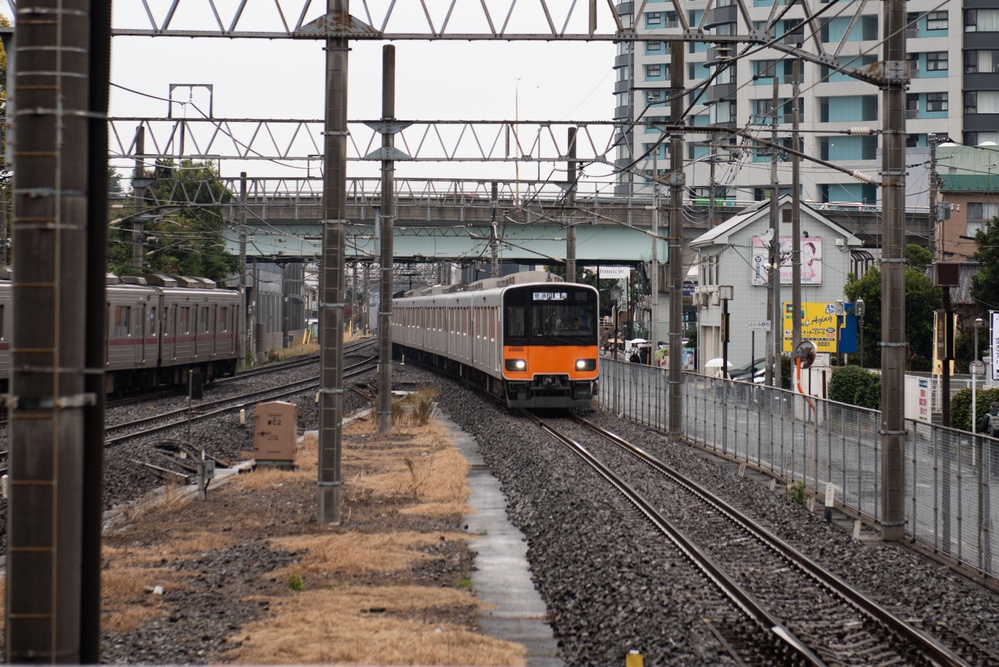
Photo By Taylor Ardito | FUJIMI, Japan (November 25, 2025) - A train arrives at Fujimino Station. Fujimino...... read more read more
 Subscribe
Naval Air Facility Atsugi, Japan (December 23, 2025) – Every winter, the Tokyo metro area hosts the 10 Railway Company Stamp Rally, a massive scavenger hunt that stretches across the Kanto Plain. Naval Air Facility (NAF) Atsugi, located a few miles south of the Kanagawa and Tokyo boarder with easy access to several train stations, is a great location for starting the journey that takes you throughout the seemingly endless urban metropolis.
During my tour in Japan I have been an avid stamp collector, documenting my travels across the country by rail. I have completed several stamp rally events in the past but the 10 Railway Company Stamp Rally is my favorite due to the difficulty, complexity and vast scale.
This rally requires the participant to collect two limited edition ink stamps in an issued stamp book and one trading card for each of the 10 companies. Most of the stations near NAF Atsugi have the stamp books in the display areas near the ticket gate.
While it may seem simple, the locations for these stamps are often deep into the outskirts of the city limits or tucked into hard to access locations with great distances between.
This rally requires hours of planning and dozens of hours of train travel to complete and is both mentally and physically exhausting. With all of the crowded trains and platforms with standing room only, tens of thousands of steps, dozens of flights of stairs and cold weather, it is easy to get discouraged. Despite the negative aspects, this rally was an exciting adventure that I am looking forward to participating in again next year.
I was first introduced to the hobby of stamp collecting when I completed the 10 Railway Company Stamp Rally two years ago. Since then I have been traveling Japan collecting stamps at train stations, rest stops, shrines, and castles. With this hobby, I have also been falling deeper into the Japanese train sub-culture, collecting train cards, stickers, and a variety of other items that employees often give away for free at stations if you ask.
The first day of my journey I picked up a stamp book from Sagami-Otsuka Station and set off heading north to Saitama Prefecture to collect the stamps on the North and West sides of the Kanto Plain. I arrived first at Fujimino Station, a small local suburban station on the Tobu-Tojo Line, before heading back south, following a parallel path with the western mountains on the way back to NAF Atsugi.
This path required taking a variety of different lines, some of them were very unique and not even trains. The Seibu Yamaguchi Line, the line required to get the stamp at Seibuen-yuenchi Station, is a people mover, a rubber tired four-car vehicle that operates on a single dedicated paved path. This line is primarily used to shuttle people to and from the nearby baseball stadium and amusement park.
Further south is the Tama Monorail Line, one of the lines that can be used to get the stamp at Takahatafudo Station, an elevated straddle beam monorail that services many of the urban centers to the west of Tokyo. This elevated line, located high above the city streets, provides beautiful views of the nearby city landscape and the mountains to the west.
The views from the elevated tracks combined with the different and unique modes of transportation resulted in a fun first day. I thought after doing this rally in the past I would not experience anything new, but the journey has taken me on lines, stations and vehicles that I had never seen before.
After making a lot of progress on the first day, I was motivated to begin the second day of exploration. I set out from Yamato Station heading towards the furthest point, Miraidaira Station, a small station to the northeast of Tokyo in Chiba Prefecture on the Tsukuba Express Line.
Despite my frequent train travel and daily use of Yamato Station for commuting to NAF Atsugi via the Sotetsu Main Line, I underestimated the force of the Odakyu Enoshima Line morning rush to Shinjuku. My motivation quickly dissipated as I lined up in one of the seemingly endless lines of people waiting for the next train to arrive on the elevated platform.
The platform was full of people and organized like a military formation with two lines waiting at each marked location on the platform where the train doors would be. The platform became a game of Tetris as people arriving up the stairs and escalators moved quickly, weaving through the lines, looking for a place to stand.
When the train arrived and came to a complete stop, all of the lines stretching down the platform simultaneously moved in unison, splitting to each side of the train doors, creating gaps for the passengers on the train to have room to exit. The choreography was seamless.
My awe of the reorganization of hundreds of people on the crowded platform was short lived as I squeezed my way into the overly crowded train. When the doors closed, I was completely packed in. I felt pressure from all sides and was unable to move. If I were to pass out, I would likely still be standing due to the people crowded around me.
At each stop, the dance of transferring of hundreds of people on and off the platform would occur. As the doors would open people inside the train would silently push and shove their way to the exit with urgency, desperately trying to exit before the lines on the platform would enter leaving no room for escape. At each station the passengers formed into an ocean current that went to and from the platform and would leave anyone who hesitated stranded behind. The people on the platform would wait anxiously, waiting for perfect timing to pounce into the train to secure a spot for themselves.
As the train would fill, the people still on the platform would get more desperate, pushing their way into the crowded train car to ensure they would have a claim to a few square inches of real estate. People already in the car would be pushed deeper into the train by the crowd funneling in. There was no resentment by those being pushed against their will, there is a mutual understanding where the victim knows they would be the aggressor if the roles were reversed.
As the last few people pushed their way through the doors of the train, the people at the edge would grab onto anything they could to secure themselves from being pushed back onto the platform, forming a wall across the entrance to the train. Even as a wall of commuters completely covered the entrance door to the train, a few stragglers would arrive just in time before the doors closed.
Unable to fit through the people blocking their entrances, the straggler would face the wall of opponents, offer a slight bow of apology, execute an about face, walk backwards, and push themselves through until they themselves became part of the human barricade. When the doors closed everyone settled into their positions, patiently waiting for the next stop and for the chaos to begin again.
What was amazing about this experience was the lack of sound. All of the commotion with hundreds of people was done in complete silence. The experience was jarring at first, but I accepted it knowing that I was in the same situation as hundreds of other people. There was a unique sense of camaraderie, I was fully immersed in the shared experience. It was an opportunity to live, travel, commute, and communicate with my neighbors without the typical language or social barriers and experience a small glimpse of Japanese working culture.
I survived the journey north and covered the north and east sides of the Kanto Plain, collecting stamps and trading cards. This day was the opposite of the previous day I spent near the mountains, this day was spent mostly in the heart of Tokyo, going through Ginza, Nihonbashi, Akihabara, and Ueno.
I spent the third and final day of my adventure collecting all the stamps in Kanagawa Prefecture and the few I was missing in the south of Tokyo Prefecture. I started the day heading south to get the stamp at Zushi Station before heading north to Kawasaki.
I felt nostalgic as I rode the Keikyu Zushi Line north past Commander, Fleet Activities Yokosuka’s (CFAY) Ikego Family Housing Facility, remembering collecting the stamp at the nearby Jimmuji Station during the last stamp rally and my daily commute on the Keikyu Main Line when I worked at CFAY.
As I went further north, I was mesmerized by the views from the elevated tracks going through Yokohama and Kawasaki, taking in the dense urban landscape and looking down at the bustling areas below. It was amazing to see the scenery change from the quiet beach city of Zushi to the massive urban port cities on the Tokyo Bay.
From there the urban sprawl continued into Tokyo as I collected stamps at Ookayama, Kyodo, and Fujimigaoka stations. This route required a transfer at Shibuya Station and ended at a train store in Shinjuku station where I collected one of the trading cards.
Navigating Shinjuku and Shibuya stations, the two busiest train stations in the world in terms of number of daily passengers, was a hectic but good experience. This stamp rally took me to massive stations like Shinjuku, a station that sees over 3 million riders per day, to small rural stations like Kunugiyama Station that only has about 3 thousand riders per day.
It was interesting to see the opposite ends of such a massive and intricate rail network. Seeing firsthand the many train lines servicing the small rural stations on the outskirts of the city move people like veins to the heart of the massive city center stations and then pumping them back out in all directions with such precision and ease is truly a marvel to witness.
I have been actively traveling the Kanto Plain by rail for the last three years, spending a lot of my free time exploring and completing multiple stamp rallies. Before setting out to start this rally I thought I had already seen everything and been everywhere, but I did not realize until the third day how wrong I was. The more places I went, the more I discovered how little I had explored in this seemingly endless urban metropolis.
This rally took me by train through Kanagawa, Tokyo, Saitama, and Chiba Prefectures, and to parts of the Kanto Plain I did not even know existed. Some places I had been to many times before, but many of them I would not have traveled to if it had not been for this rally. I am glad to have had a reason to go to these places and explore neighborhoods in the Tokyo Metro area I had never been before. Even though I have just finished this rally, I am already excited to find out where it will take me next year.
Whether you are a rail fan, train enthusiast, traveler, scavenger hunter, or a person who wants to get away from the tourist traps, this rally is for you. Start now because this year’s rally ends January 25, 2026. NAF Atsugi has a lot of fun things to do inside the base\, but from time to time it is good to get beyond the gate, pick up a stamp book and enjoy your duty in Japan.
NAF Atsugi supports the combat readiness of Commander, Fleet Air Western Pacific, Commander, Carrier Air Wing (CVW) FIVE, Helicopter Maritime Strike Squadron (HSM) 51 and 23 other tenant commands, and provides logistic support, coordination, and services to units assigned to the Western Pacific.
| Date Taken: | 12.22.2025 |
| Date Posted: | 12.23.2025 00:08 |
| Story ID: | 555195 |
| Location: | KANAGAWA, JP |
| Web Views: | 285 |
| Downloads: | 0 |

This work, Duty in Japan – Exploring the Kanto Plain by Rail, by Taylor Ardito, identified by DVIDS, must comply with the restrictions shown on https://www.dvidshub.net/about/copyright.

No keywords found.




