
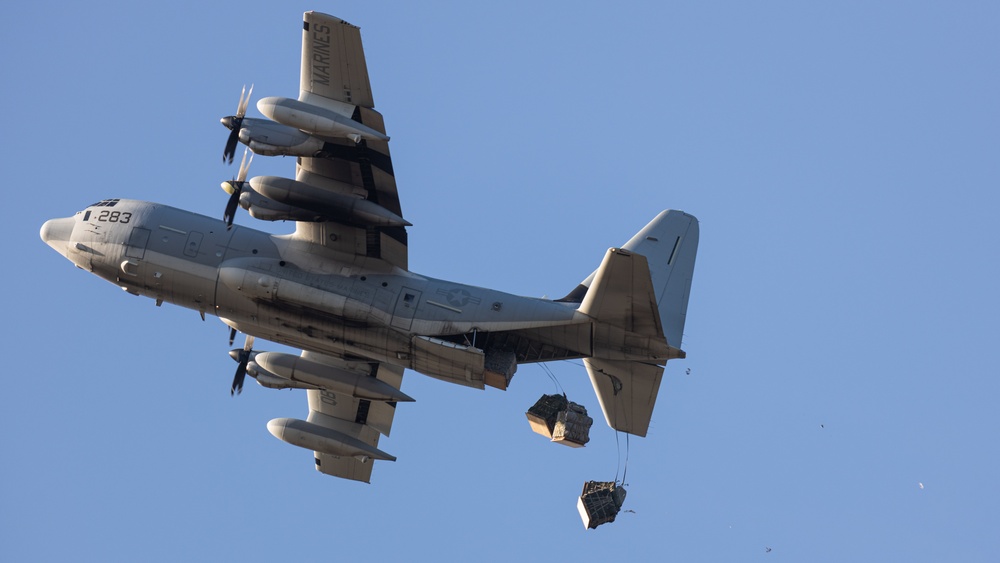
Photo By Cpl. Ryan Ramsammy | A U.S. Marine Corps C-130J Super Hercules drops pallets while conducting air delivery...... read more read more
 Subscribe
MARINE CORPS BASE CAMP PENDLETON, Calif. – U.S. Marines from Combat Logistics Regiment 1, 1st Marine Logistics Group provided tactical logistics support to elements of 1st Marine Division, I Marine Expeditionary Force in a simulated non-permissive environment during Exercise Steel Knight 25 Dec. 1 – 14.
Steel Knight 25 was a scenario-based exercise designed to evaluate and certify the next iteration of Marines for Marine Rotational Force – Darwin. Steel Knight also served as a proof of concept for emerging tactics of a crucial warfighting function – logistics.
“Steel Knight deliberately focused on how to conduct multi-modal distribution in a contested and dispersed environment,” said Maj. Jonathan Chavez USMC, Operations Officer with Combat Logistics Regiment 1. “This focus of effort challenged not only the logistics formations to think of alternate forms of sustainment, but also enabled the Task Force and Joint Partners to integrate and solve complex distribution problems that will require a whole of effort approach going into our next near peer conflict.”
Logistics is the pacing function for operations. Without the sustainment of vital supplies, formations of all sizes experience reduced combat potential and are more vulnerable to attacks from the enemy. Traditional lines of logistics, such as long supply chains safe in the rear, are liabilities on the modern battlefield where they are easily targeted, often without risk to enemy forces.
To sustain forces across the battlespace, logistics units must forecast consumption of supplies including fuel, food, and ammo. Getting supplies and providing maintenance becomes more difficult when lines of supply are threatened by enemy weapons systems. With units, in need of logistical support, being located on different islands the problem becomes more complex. To combat these vulnerabilities, Marines across 1st MLG are magnifying their position as subject matter experts by providing novel and survivable options for commanders to fulfil the needs of combat units.
In anticipation of the next fight, 1st MLG is modernizing its tactics and adopting a philosophy of survivable and resilient sustainment, designed to thrive in the most austere, contested, or nonpermissive environments. Steel Knight 25 allowed the Marines and Sailors of 1st MLG to rehearse sustainment operations in a contested environment, based on observations from recent conflicts. Flexibility, redundancy, and survivability in logistics operations are critical to success.
1st MLG has taken decisive action over years to invest in its people and platforms maximizing survivability and effectiveness in dispersed formations without compromising any class or function of supply. Additionally, prepositioning of resources, such as cache sites, enhance the sustainability of operations across the battlespace, to achieve the greatest success rate. These pre-staged materials provide commander’s flexibility to engage the enemy knowing they will have ammunition, food, fuel, and other critical supplies to continue the fight.
Logistics units participating in Steel Knight 25 rehearsed flexible logistics operations while maintaining dispersed command and control. 1st Distribution Support Battalion, Combat Logistics Regiment 1, utilized aircraft to facilitate resupplies. Through air delivery operations, 1st DSB created a more robust sustainment network to support operations. Multi-domain webs of support ensure units in need of resupply are not limited to land resupply, but can receive critical support from the air, land, or sea.
The modern battlefield is rife with threats to logistics operations. Threats like small unmanned arial systems can target supply caches, refueling points, or combat formations without exposing the enemy to risk. In response to emerging threats, Marines with Headquarters and Service Battalion, 1st MLG prioritized survivability of their operating positions.
To increase survivability, Headquarters and Service Battalion, 1st MLG, dug trenches and earthwork ports. Between resupplies, maintenance functions, or health services support, vehicles were parked below the earth, concealed by camouflage netting.
“Our goal was to focus on implementing new ways to mask signature in an ever-changing battle space,” 2nd Lt. Kyle Hansen who served as the camp commandant for H&S Bn during Steel Knight 25 said of the operating site. He continued by stating, “H&S Bn was able to utilize thermal signature masking cammie netting to improve a defensive logistical node and establish a functioning command and control suite, that enabled decision makers to accomplish the mission.”
Though the location of the future fight is undetermined, 1st MLG has set the foundation for future success. Through practicing decentralized command, leaders are empowered to act proactively across a dispersed battlefield while providing crucial support to combat formations. By learning from contemporary examples of warfare, identifying threats to logistics networks, and refining tactics 1st MLG is underwriting the lethality of the MEF.
| Date Taken: | 12.18.2025 |
| Date Posted: | 12.19.2025 18:31 |
| Story ID: | 555027 |
| Location: | MARINE CORPS BASE CAMP PENDLETON, CALIFORNIA, US |
| Web Views: | 167 |
| Downloads: | 1 |

This work, Sustaining the Fight: 1st MLG Rehearses Contested Logistics During Steel Knight 25, by 1LT Tyler Judd, identified by DVIDS, must comply with the restrictions shown on https://www.dvidshub.net/about/copyright.


No keywords found.




