
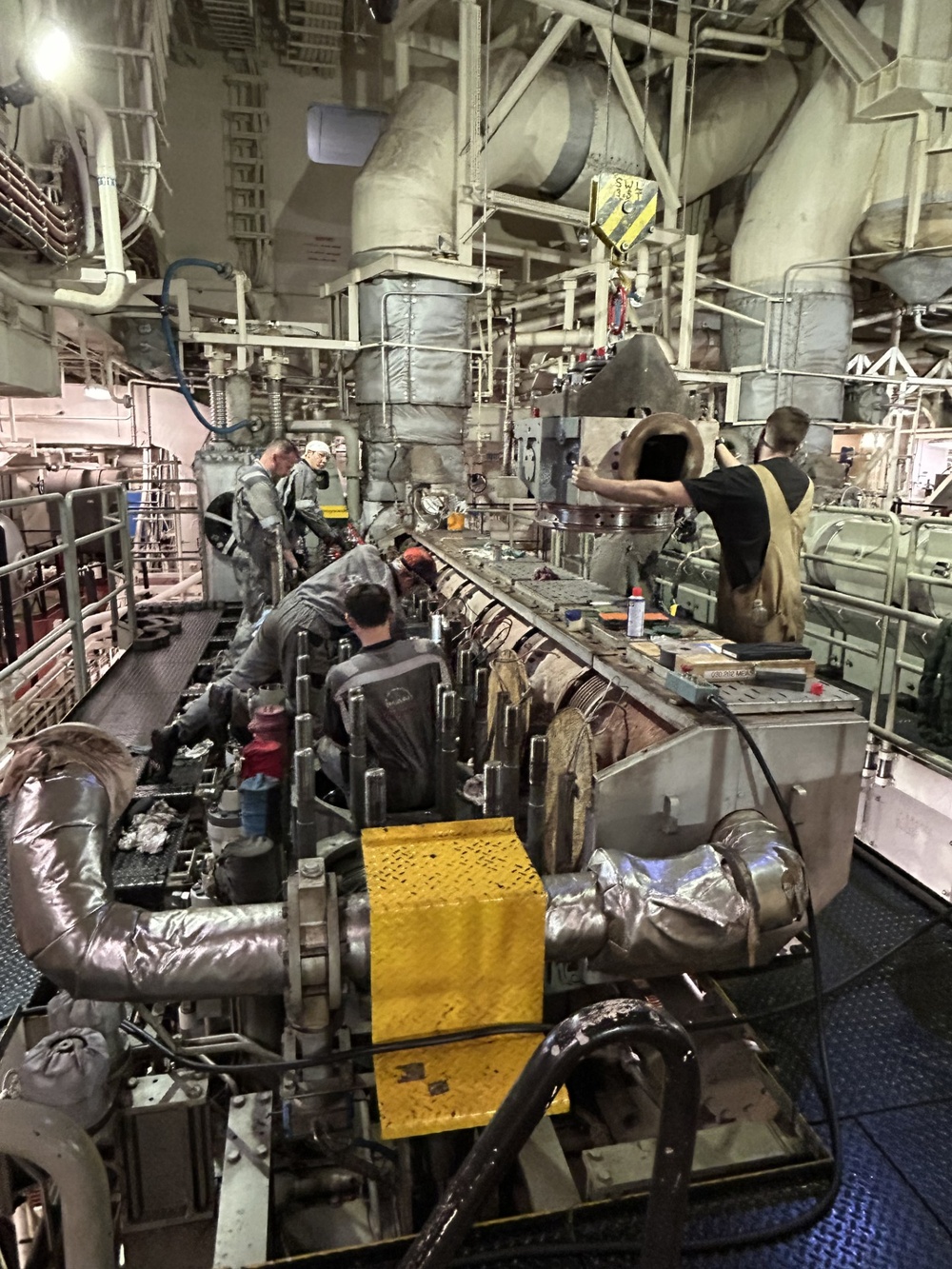
Photo By Molly Burgess | Civilian Service Mariners (CIVMARs) aboard the Lewis and Clark-class dry...... read more read more
Shipyards have historically been the location for major vessel maintenance, but a new initiative may be the driving force in changing the way Military Sealift Command (MSC) conducts ship engine overhauls in the future.
The MSC initiative would remove major engine maintenance and overhauls from being completed while pier-side during in-port availability periods, to being performed while the ship is underway and operational.
“It’s an initiative to change our engine maintenance from a siloed process of keeping everything in two parts, maintenance and operational, to putting maintenance on a continuum,” said Zach Mauer, MSC’s Mechanical Engineering Branch Head. “So, if it’s redundant machinery, we can do maintenance anytime, anywhere.”
According to Mauer, the initiative derives from standard commercial methods where commercial shipping and cruise ship industries contract teams from the diesel engine’s original equipment manufacturer (OEM), Everllence, to conduct engine overhauls while at sea.
“It’s common practice for commercial industry to fly in one lead engineer and the ship’s force works alongside them,” Mauer said. “In doing engine maintenance this way, it reduces time spent in shipyards and expands their maintenance efficiency.”
Mauer said that because MSC’s combat logistic force ships are built to commercial shipping standards and powered by the same commercial marine diesel engines, implementing best commercial maintenance practices on MSC ships would bring major benefits.
“One of the biggest benefits is the amount of technical development the crew gets from interacting and engaging with the OEM experts that come to the ship,” Mauer said. “You build a crew that become experts in the machinery that run the ship, not just operators.”
Andy Busk, MSC Engineering Director, said it also builds professional development for the crew, and in turn can help towards advancement and personal growth.
“It provides the crew the opportunity to obtain certifications, and enhance professional and personal development,” said Busk. “This combines the training with the operational side where you are building those professional skillsets at your job, while doing your job.”
Mauer said conducting at-sea overhauls would reduce shipyard delays, citing internal MSC statistics from 2023 where he said there were a total of seven shipyard extensions with a combined 191 days of delay, specifically related to engine maintenance or repair.
“This out-to-sea maintenance process would eliminate engine-associated delayed shipyard extensions and allow for better mission readiness,” Mauer said.
Busk said the biggest difference is being logistically prepared, resulting in the transfer of risk for an at-sea overhaul being extremely low.
“There isn’t any transfer of risk from the technical side to the operational side,” Busk said. “It becomes a risk reduction because you are in a highly controlled environment with leading OEM engineers.”
This past July through September, Mauer and his team were able to implement “proof of concept” aboard the Lewis and Clark-class dry cargo/ammunition ship USNS William McLean (T-AKE 12) when a team of Everllence technicians boarded the ship and conducted an overhaul on two of the ship’s diesel engines and a major overhaul on a third.
McLean’s resident Chief Engineer Paul Snyder, who has been working for MSC since 1997, said he had never done anything like this before and was highly impressed with the process.
“Having the opportunity for the crew to engage with the OEM technicians while conducting the overhauls, was a great benefit,” said Snyder. “To be able to accomplish what we did while underway and to also remain on mission, puts into perspective of how valuable this maintenance process is.”
Snyder said the first two engine overhauls took just over two weeks to complete, and the third major overhaul was completed in about a month. He added “the same maintenance combined and completed in a shipyard would take twice as long.”
“It would be my desire to do all my engine overhauls in this manner with the OEM technicians because the level of professionalism and proficiency they displayed, greatly exceeded any other overhaul that I’ve been a part of in the past, by a substantial margin,” said Snyder. “The knowledge, efficiency, professionalism, price - everything about doing it this way was a benefit to MSC.”
Mauer’s vision is to expand the at-sea engine maintenance and overhaul process to other MSC vessels on a class-by-class basis where it is safe and appropriate, while advancing the crew’s technical skills.
“A corrective maintenance item becomes a casualty when the crew isn’t given the parts, tools, or professional training needed to fix an issue without requiring industrial assistance,” said Mauer. “By giving our crews the opportunity to gain on-the job training while working alongside the OEM, we empower them to become experts of their trade. This will drive a significant upward trend in both self-sufficiency and reliability.”
MSC directs and supports operations for approximately 140 civilian-crewed ships that replenish U.S. Navy ships at sea, conduct specialized missions, preposition combat cargo at sea around the world, perform a variety of support services, and move military equipment and supplies to deployed U.S. forces.
| Date Taken: | 12.17.2025 |
| Date Posted: | 12.18.2025 15:52 |
| Story ID: | 554824 |
| Location: | US |
| Web Views: | 482 |
| Downloads: | 1 |

This work, New initiative paves the way for future MSC ship engine overhauls, by Molly Burgess, identified by DVIDS, must comply with the restrictions shown on https://www.dvidshub.net/about/copyright.

No keywords found.





