
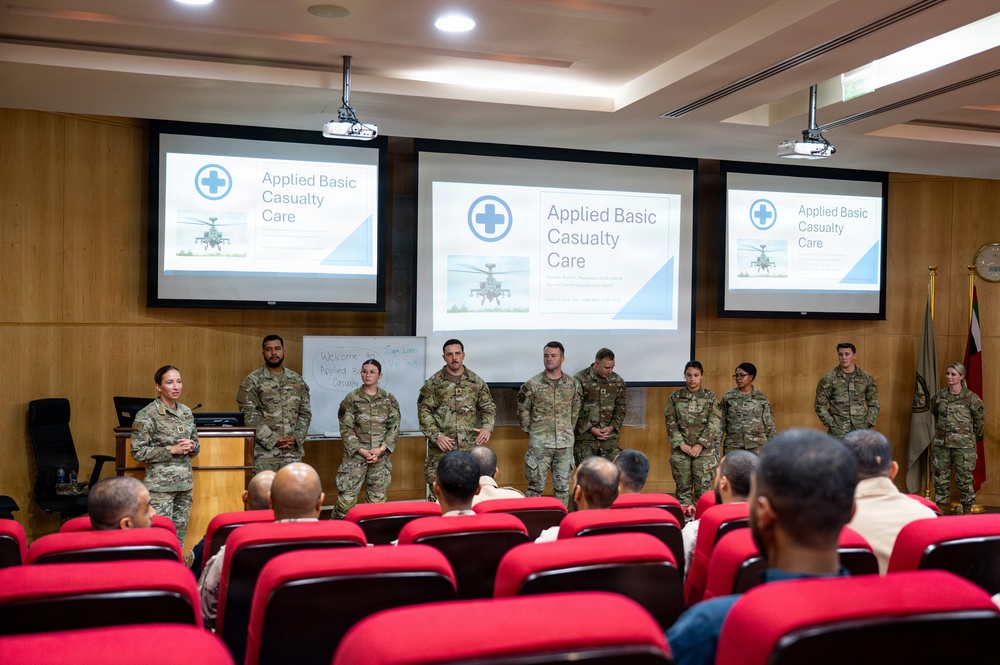
Photo By Master Sgt. James Cason | U.S. Airmen assigned to the 380th Expeditionary Medical Element, instruct tactical...... read more read more
 Subscribe
U.S. CENTCOM – Speaking with purpose to the Airmen accompanying her, U.S. Air Force Capt. Haley Lord, 380th Expeditionary Medical Element physician assistant, told them the plan had changed. Instead of having two to three hours to brief and train tactical combat casualty care to more than 90 Emirati helicopter crew members, they now had only an hour … no slides, no theory, just direct, hands-on instruction.
For these Airmen, that was no issue. They paired off, brought in their teaching aids, set up training stations on the Emirati auditorium stage and were ready in less than ten minutes. Across three stations, they’d prepared everything needed to teach the five priorities of TCCC care: massive bleeding, airway, respiration, circulation and hypothermia prevention.
With the stage set, the Emirati pilots began to file in.
The coordination for the event began two weeks earlier, when Lord was chosen to lead the first formal survive, evade, resist, escape and TCCC collaboration between 380th Airmen and an Emirati helicopter unit.
“For the U.S. Air Force, the motivation was to strengthen interoperability and survivability among our partner nation’s aircrews,” said Lord. “Personally, I wanted to empower aviators to take ownership of their survival and medical response in austere, high-stress environments.”
Lord said the team was excited for the opportunity and mindful of cultural differences and as the pilots gathered around their instructors, engagement picked up quickly.
What began as a guarded interaction developed into an energetic exchange, unifying Emiratis and Airmen as one team learning to save lives in combat.
“I was elated about how well we integrated with the Emiratis and incredibly proud of my team that helped me from the clinic,” said Lord. “The pilots were highly engaged, asked sharp, high-level questions and performed skillfully during the mannequin-based trauma stations.”
In the span of an hour, the pilots may not have mastered every TCCC technique, but the shared focus and conversations made clear the value of face-to-face collaboration.
“This experience reinforced how powerful multidisciplinary teamwork is,” Lord said. “Watching our medics and the Emiratis collaborate across cultural lines reminded me that readiness is universal. From a teaching perspective, it emphasized that realism, repetition and relevance are key.”
Lord said she hopes the success of the session lays the groundwork for future integration. “Partner nation leadership expressed strong interest in recurring sessions and expanding to include flight line response and medical evacuation drills,” she said.
She added that she hopes the Airmen take pride in what they accomplished.
“I hope the team walks away with a sense of purpose knowing their technical skills translate into real-world impact, and the understanding that readiness training isn’t just a checkbox, but a chance to contribute to our allies’ capabilities and grow as leaders in joint and coalition environments,” said Lord.
This TCCC session gave Airmen and Emirati pilots the chance to work side by side, trading techniques and perspectives as they sharpened their approach to combat medical response. After the Emirati pilots filed out, the energy of the training lingered.
SSgt Crisanta Strojny, 380th Expeditionary Medical Element technician, said, “The training with the Emirate Apache crew was a once in a lifetime experience and I’m grateful for the opportunity. We integrated really well, and they were eager to learn.”
For the Airmen breaking down their stations, the conversations and engagement they’d just been a part of made it clear the hour had accomplished more than just a brief skills training. It built familiarity, confidence and trust between two teams who may one day rely on each other under far harsher conditions.
The strong engagement and interest in continued integration signal growing momentum for future joint training, and for a partnership strengthened not just by shared missions, but by shared moments like this one.
| Date Taken: | 11.11.2025 |
| Date Posted: | 12.02.2025 01:04 |
| Story ID: | 552719 |
| Location: | (UNDISCLOSED LOCATION) |
| Web Views: | 85 |
| Downloads: | 1 |

This work, TCCC: Training side by side, by MSgt James Cason, identified by DVIDS, must comply with the restrictions shown on https://www.dvidshub.net/about/copyright.


No keywords found.




