
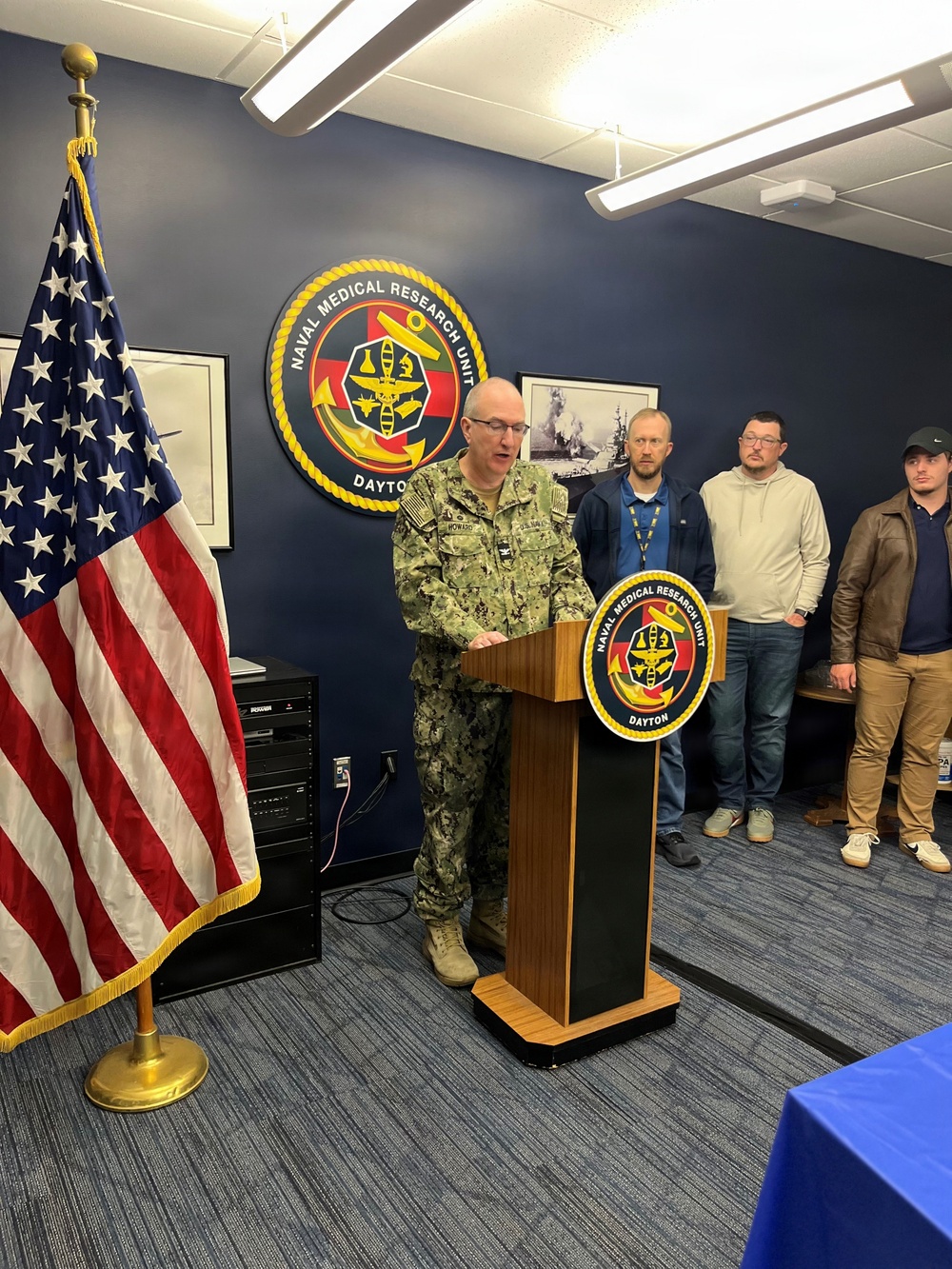
Photo By Zachary Wilson | U.S. Navy Capt. William Howard, NAMRU Dayton Commanding Officer gives remarks at an...... read more read more
WRIGHT-PATTERSON AIR FORCE BASE, Ohio --Naval Medical Research Unit (NAMRU) Dayton marked its 15th anniversary last month, commemorating a decade and a half of advancing Naval Medical Research and Development (NMR&D) and strengthening the health, readiness and performance of U.S. service members. The Command hosted an observation event Oct 10 that highlighted both the creation of the Command as well as the celebration of the U.S. Navy’s 250th birthday. Due to the shutdown of the federal government at the time, the event was small in attendance but not in significance.
“We celebrate the 15th anniversary of one of the Navy’s vital medical research commands in the shadow of the Navy’s 250th birthday -- mindful that NAMRU Dayton provides the research that forms the foundation of innovation essential to sustaining our Fleet,” said U.S. Navy Capt. William Howard, NAMRU Dayton Commanding Officer.
Roads to NAMRU-Dayton Prior to the establishment of the Command in 2010, the Environmental Health Effects Laboratory (EHEL) was already located at Wright-Patterson Air Force Base, serving as the U.S. Navy’s Toxicology Program of Record. EHEL had previously been relocated to Wright-Patterson in 1976 from Bethesda, Md. in order to coordinate efforts with U.S. Air Force partners. Meanwhile, the 2005 Base Realignment and Closure (BRAC) Act directed the relocation of the Naval Aerospace Medical Research Laboratory (NAMRL) from Naval Air Station (NAS) Pensacola in Florida to Wright-Patterson to form the Navy component of a new joint Center of Excellence (CoE) for Aeromedical Research. This CoE placed NAMRL alongside the U.S. Air Force School of Aerospace Medicine and other AFRL elements, creating an integrated hub for aerospace medical science. Navy Medicine, recognizing the proximity of two Navy research units on the same installation, decided to combine NAMRL and EHEL under a single command: Naval Medical Research Unit Dayton.
“Navy Medicine’s decision to put EHEL and NAMRL under one command brought together two components with unique research missions, each with their own rich history,” said Dr. Karen Mumy, EHEL Director. “While our missions may not appear related at face-value, the labs flow together very nicely and, in fact, have had a number of opportunities for collaboration over the last 15 years.”
Dr. Rick Arnold, NAMRL Director, noted the potential for growth and increased collaboration with Air Force partners as a result of the creation of NAMRU-Dayton.
“Leaving the ‘Cradle of Naval Aviation’ in Pensacola presented challenges and difficulties for NAMRL, but these were more than compensated by the outstanding new facilities and partnerships for NAMRL at Wright Patterson AFB, not only with our USAF Aeromedical Research colleagues, but with EHEL as well, who in addition to their outstanding non-aviation research, broadened the capabilities to conduct Aeromedical research at NAMRU-D,” he said. Activation and Early Growth NAMRU-Dayton was officially established on Oct 1, 2010. Its activation ceremony, held on Oct 6, 2010, was presided over by Capt. Richard Haberberger, Commanding Officer of what was then Naval Medical Research Center, now Naval Medical Research Command (NMRC). Rear Admiral Eleanor Valentin, Commander, Naval Medical Support Command, served as the honored guest speaker. Capt. Keith Syring became the first Commanding Officer, with Cmdr. Rita Simmons as the inaugural Executive Officer. In November 2010, NAMRU-Dayton’s first organizational chart listed a staff of just 34 personnel. Over the course of 2011, the remaining NAMRL workforce relocated from Pensacola to Dayton. By the end of that fiscal year, NAMRU-Dayton had nearly doubled in size to 67 personnel --almost half of its present-day workforce size.
Early Research Milestones NAMRU-Dayton’s early research included foundational work across both its major mission areas: In EHEL, research advanced the landmark Women in Submarines study, which demonstrated that submarine atmospheres were safe environments for fetal development -- an essential research effort supporting the Navy’s decision to integrate women into submarine service. NAMRL, conducting Aerospace and Operational Medicine Research, transferred core programs from Pensacola to Dayton, including spatial disorientation, hypoxia, and fatigue countermeasure research. At the time, the Disorientation Research Device (DRD) --now known as the Kraken -- was little more than an excavation site on the east side of Building 851.Together, these efforts laid the groundwork for the multidisciplinary portfolio NAMRU-Dayton manages today.
Fifteen Years Forward: Supporting the Fleet and the Force Since its establishment, NAMRU-Dayton has grown into a premier Navy research command focused on understanding environmental exposures, enhancing performance, improving aerospace medical safety, and ensuring the health and readiness of Warfighters operating in demanding environments. As the Navy marks its 250th year, NAMRU-Dayton’s mission remains firmly aligned with the fleet’s enduring operational needs.
“The relocation of the Navy’s Aerospace Medical Research Laboratory to Wright-Patterson Air Force Base carried forward a proud Navy legacy in aerospace medicine, while enabling close collaboration with our Air Force colleagues in Dayton -- the birthplace of aviation science,” Howard said. “Combined with the enduring tradition of military toxicology here, which includes the embedded support of the Army, NAMRU Dayton has thrived for 15 years in a true tri-service environment, continuing a legacy of innovative contributions to warfighter readiness.”
| Date Taken: | 11.20.2025 |
| Date Posted: | 11.21.2025 09:42 |
| Story ID: | 552026 |
| Location: | US |
| Web Views: | 244 |
| Downloads: | 0 |

This work, NAMRU-Dayton Celebrates 15 Years of Advancing Warfighter Readiness and Human Performance, by Zachary Wilson, identified by DVIDS, must comply with the restrictions shown on https://www.dvidshub.net/about/copyright.


No keywords found.





