Nebraska National Guard Soldiers and Airmen embarked on an immersive leadership and professional development journey designed to deepen their understanding of military history and its lessons, Aug. 22-26, 2025.
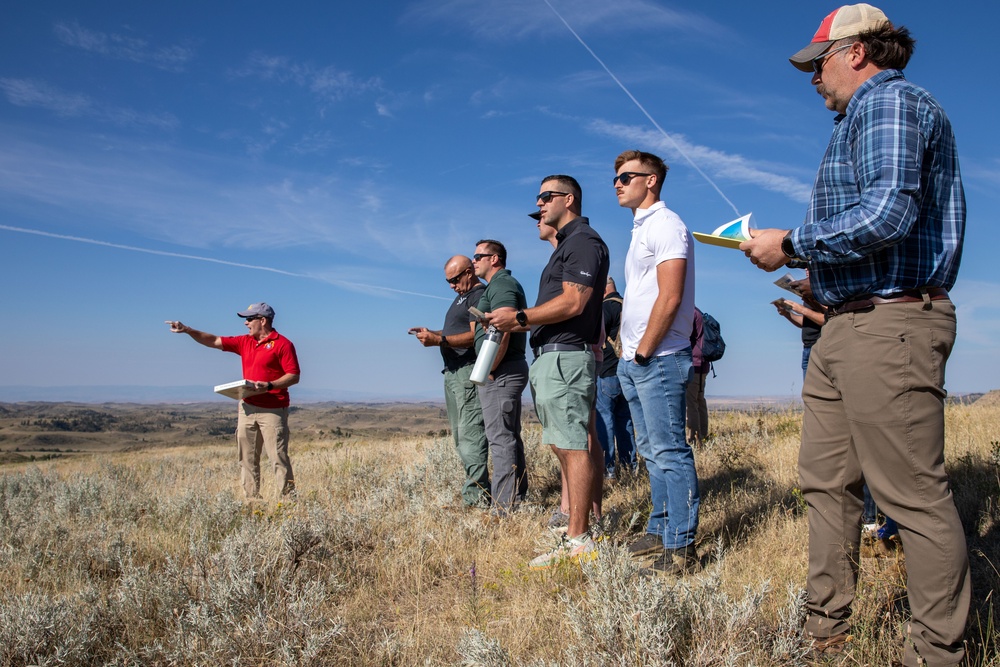
The journey, formally called a “staff ride”, took the Soldiers and Airmen to multiple locations including Fort Robinson, Little Bighorn, Fort Laramie and sites along the Oregon Trail, where they learned about these important historical sites as well as important leadership skills. The staff ride's format was unique and highly effective. Each participant was required to complete a series of mandatory and optional readings, including “A Terrible Glory, Custer and the Little Bighorn.” This preparation served as the foundation for each Soldier’s and Airman’s individual oral briefings, each lasting 10-15 minutes. These briefings, delivered on-site at the historical locations, allowed the Guardsmen to act as subject matter experts on topics ranging from the Cheyenne Breakout at Fort Robinson to the Battle of Washita.
The experience of presenting in the very locations where history unfolded made the lessons palpable and unforgettable.
"Listening and giving briefs related to the site we were currently at was great," said Staff Sgt. Daniel Kerrigan, 155th Air Refueling Wing. “My favorite site we visited was Fort Robinson because of the history of the fort and the surrounding nature was beautiful.”
The keystone event of the staff ride was at the Little Bighorn battle site where the group was joined by two instructors from the Combat Studies Institute at Fort Leavenworth, Kansas. There, the group walked through the battle hour-by-hour, frequently stopping at important locations while discussing the rough timeline of events.
"I liked how we broke down Custer’s decision making, step-by-step, based on the information he had at the time," Kerrigan said. “It made us think about how his decisions were failures, or not, and what he could have done better.”
The Battle of Little Bighorn, often referred to as "Custer's Last Stand," took place on June 25-26, 1876, in eastern Montana Territory. It was a key engagement in the Great Sioux War of 1876, a conflict between the U.S. Army and a coalition of Lakota Sioux, Cheyenne and Arapaho tribes.
Led by influential figures like Sitting Bull and Crazy Horse, the Native American forces were gathered in a large encampment near the Little Bighorn River. The battle began when Lieutenant Colonel George A. Custer, leading the U.S. 7th Cavalry, launched an attack on the encampment, underestimating the size and determination of the opposing forces. The resulting battle led to a decisive victory for the Native American coalition and the complete annihilation of Custer's immediate command.
The battle is a pivotal moment in American history, known for its strategic miscalculations and tactical errors.
The staff ride is part of a Nebraska National Guard initiative designed to help prepare Soldiers and Airmen for future challenges by learning how leaders made decisions in the past.
“The Adjutant General, Maj. Gen. Craig Strong, has wanted a staff ride program that was Nebraska centric for years,” said Maj. Edward Bosland, outgoing commander of the 105th Military History Detachment. “Here in Nebraska we have a rich cavalry history, with Fort Robinson especially, and that is how we were able to connect it with the Battle of Little Bighorn and Custer’s 7th Cavalry.”
At Little Bighorn, the terrain itself became a classroom, offering a vivid understanding of the challenges faced by both Custer's forces and the Native American warriors. The absence of modern conveniences served as a powerful reminder of the austere conditions under which historical campaigns were fought.
“We were really lucky with the [subject matter experts] that joined us on our trip,” said Maj. Luann Brown, incoming commander of the 105th Military History Detachment, referencing retired colonel and state senator Tom Brewer, Congressman Don Bacon, as well as Kevin Kennedy and Rob Williams from the Combat Studies Institute. “They added a lot to this staff ride and their value was immense.”
| Date Taken: |
09.08.2025 |
| Date Posted: |
09.10.2025 11:39 |
| Story ID: |
547730 |
| Location: |
US |
| Web Views: |
151 |
| Downloads: |
0 |
PUBLIC DOMAIN

This work, Fort Robinson to Little Bighorn: A Weekend of Professional Development for Nebraska National Guard Soldiers, Airmen, by SSG Gauret Stearns, identified by DVIDS, must comply with the restrictions shown on https://www.dvidshub.net/about/copyright.

 Subscribe






