WARDAK PROVINCE, Afghanistan – The 173rd Airborne Brigade Combat Team’s 4th Battalion, 319th Airborne Field Artillery Regiment (Task Force King) has embraced the rules of engagement and is taking active steps to reduce collateral damage by developing an alternative that reduces the chance of civilian casualties.
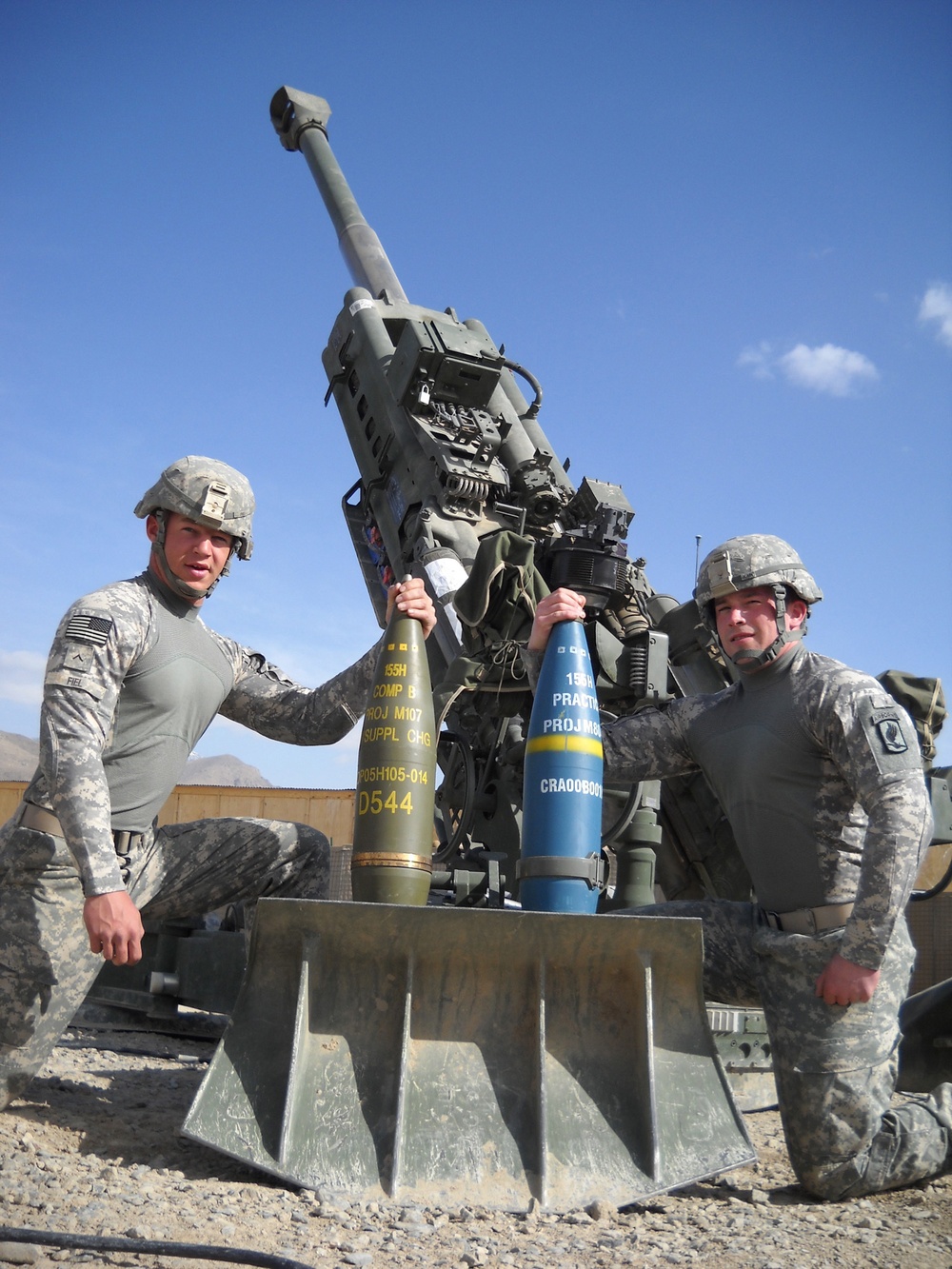
The 4-319 AFAR Task Force has begun the practice of using less-explosive training shells during the adjustment phase of fire support and quickly transitioning to the high-explosive, lethal rounds during the fire-for-effect phase. The immediate result is fewer live rounds being fired, fewer chances for an errant round to cause unintentional injury or damage, and no decrease in effect of the support to ground units.
“The insurgents are choosing to fight among the people, employing them as human shields; this amounts to an avoidance strategy,” said U.S. Army Command Sgt. Maj. Dennis Woods, 4-319th AFAR, 173D ABCT command sergeant major. “Our enemy knows when we use artillery in a conventional firefight, there [exists a] possibility of unintended collateral damage. In our efforts to avoid that, commanders have previously been far less inclined to use artillery. The enemy has been using this assumption to avoid our fire support advantage … until now!”
The less lethal training round in use is the M804A1, also known as the “Smurf” round, due to its blue coloring. In practice, it is a ballistic match for a live, high-explosive artillery round and exhibits the same effects while in flight from the tube to the target. The difference is in the impact effects.
“The 173D ABCT gives up nothing in terms of effectiveness; the fire-for-effect round is exactly where it would be had we fired an explosive artillery round,” Woods added. “This new approach that we are using here is more sensitive to the environmental impact issues along with the cultural issues that affect the Afghanistan citizens.
Because Afghanistan is an agrarian society, when high explosives are used, they can contaminate the soil. When TNT, cyclonite and octogen (all proponents of high explosives) erode into the fields, crop yields can be harmed. Using less-explosive rounds is not only good for Afghanistan’s long-term future, but bodes well by posing a far less likelihood for collateral damage, explained Woods.
“The 173D ABCT is aware how collateral damage separates us from the people,” Woods said. “Since [protection of] the people is the real objective within a counterinsurgency environment, our ability to increase public safety is the moral choice and the strategic choice that best delivers our vision.”
U.S. Army 1st Sgt. Frank C. Luedtke, Jr., the senior enlisted member of Bravo Battery, 4th Battalion, 319th Airborne Field Artillery Regiment, who hails from High Point, N.C., has fired thousands of rounds during previous OEF deployments. “The Smurf round would have been a useful asset in the counterfire fight,” he said.
“When using non-lethal munitions such as HC Smoke for marking targets, the area covered by the large masking would not allow other assets to be used because of the possibility of collateral damage. The Smurf round, when adjusted, puts off a significantly smaller signature, thus allowing the use of other assets and minimizing the possibility of collateral damage," Luedtke said.
No one [specifically] told the Sky soldiers how to avoid collateral damage or civilian casualties. The solution was arrived at through asymmetrical thinking that allowed the paratroopers to tailor their effects and deliver “focused lethality,” said Woods. “Our paratroopers chose to adjust fire with less lethal rounds to protect the citizens,” he added.
Every 155 mm M777A2 cannon crew in the 4-319 AFAR has the Smurf round on location.
“Adapting artillery’s effects supports the COIN fight,” said Woods. “There aren’t many armies that would go to this extent to increase public safety and reduce collateral damage like the 173rd Airborne is doing day in and day out.”
| Date Taken: |
07.12.2010 |
| Date Posted: |
07.12.2010 07:49 |
| Story ID: |
52698 |
| Location: |
WARDAK PROVINCE, AF |
| Web Views: |
661 |
| Downloads: |
473 |
PUBLIC DOMAIN

This work, 'Sky soldier' artillerymen use innovation to reduce collateral damage, by SSG Bruce Cobbeldick, identified by DVIDS, must comply with the restrictions shown on https://www.dvidshub.net/about/copyright.

 Subscribe





