Story and photos by Spc. Jonathan Montgomery
Third U.S. Army Public Affairs Office
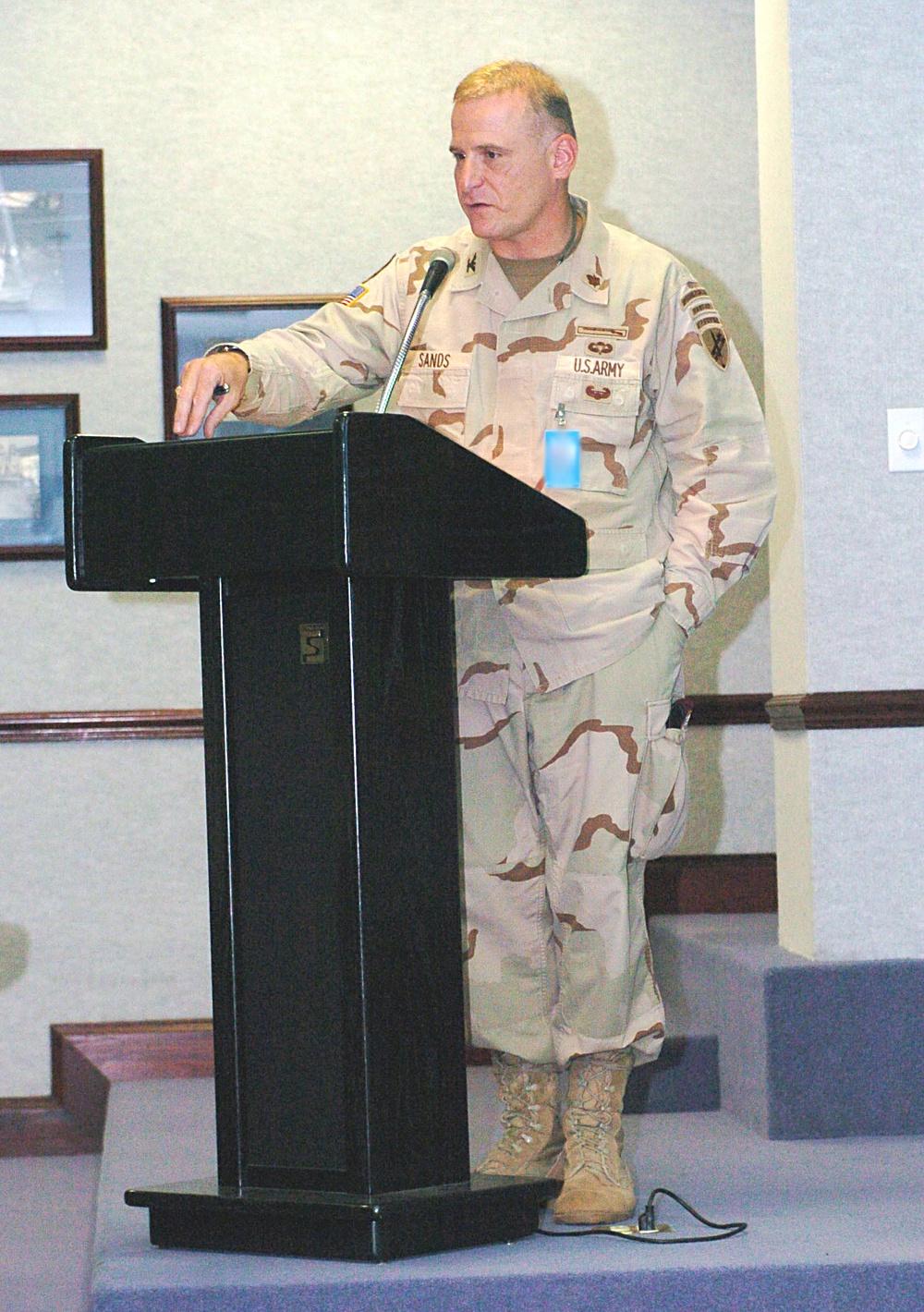
FORT MCPHERSON, Ga., (August 24, 2005) -- Third U.S. Army hosted the commander of the 360th Civil Affairs Brigade (Airborne) Aug. 24 at the Third U.S. Army Headquarters building at Fort McPherson, Ga., as an ongoing installment of Officer Professional Development guest speakers.
Col. Guy Sands-Pingot addressed the topic of "Civil Reconstruction in Afghanistan: Past, Present, and Possible Future Roles for Provincial Reconstruction Teams (PRTs)," to staff principals and other Third U.S. Army officers in attendance.
"We're here to look at the civil reconstruction efforts in Afghanistan, which remains, for the most part, a tribal society four years after intervention (following the 9/11 attacks)," said Sands-Pingot.
PRTs operate in Afghanistan and elsewhere as task-organized civil-military organizations tailored to the regional situation. PRTs coordinate civil and military operations in order to promote the authority and legitimacy of governments at the local, district, and provincial levels.
Afghanistan, in particular, is a place where PRTs are very active, said Sands-Pingot, since Afghans continues to face many challenges toward a strong yet infant democracy. These challenges include such things as competing ethnic groups, a tribal-based society, religious dominance and a lack of central governmental control over the local provinces.
The latter challenge, especially, has become a main sticking point for PRTs, said Sands-Pingot.
"We need to take a look through the eyes of the people of Afghanistan. For the most part, they don't see a central government. They really don't feel a central government. That central government does not provide for them the goods, services and protection that we understand in a western, secular concept," he explained. "Afghans neither expect nor demand assistance from "government"'reliance and allegiance is placed in other institutions. So, instead, they search and go back to that which they know, which is tribal allegiance, a society of obligations, based on obligations and religious aspects which control their lives."
In addition to a lacking central government, other concerns and issues such as opium cultivation and drug smuggling hurt the country's chances at true autonomy, said Sands-Pingot, as does the continued role of warlords who hold back emerging democratic ideals in Afghanistan by filling in the security gap intended for provincial police answerable to a centralized government.
"It's an obligatory type of relationship they (local Afghans) have. He (the warlord) provides a certain amount of security; and they owe an allegiance back to him for providing that security," he explained.
An insufficient police presence, therefore, is another destabilization factor, said Sands-Pingot.
"The people there (in Afghanistan) don't see or feel the presence of their police. They know they have police, but how effective is their police? Can they walk down their streets or their compounds and know their police will be there to protect them?"
In other words, perception is reality, he said.
"People start relying on their police when the police are resourced to look like police," said Sands-Pingot. "Too often, we've seen that the police are walking around in torn sneakers, shoddy uniforms, and carrying old weapons. People don't respect them because they don't look like police and they haven't been trained as police. A lack of trained, paid, and honest police and public safety institutions continue to threaten the overall security of Afghanistan."
Consequently, a renewed insurgency is able to grow and expand where a police force fails to exert its power and protection, said Sands-Pingot.
"The Taliban insurgency has not withered away. Rather, it has learned from past lessons," he said. "It stubbornly continues, no matter how many times we tell or show the Taliban or those who follow them, "you're defeated" or "give up". There seems to be, always, some others that are willing and ready to come in and step forward to fight the central government and, by extension, coalition forces."
One of the reasons the insurgents and foreign fighters loyal to the Taliban's radical interpretations of Islam aren't diminishing, said Sands-Pingot, is because local Afghans are having trouble adhering to a coherent national Afghan identity that ought to trump local loyalties.
"Why do bad guys come into a town or a community, and they (the local Afghans) don't kick them out? It is because they feel there's an obligation to them because there's still a tie to the family or to the tribe," he explained. "Somehow, over a period of time, as we build, as the Afghans build their state, the people will need to shift their allegiance more and more from the tribal, the local, to the wider sense of being Afghans."
The way to shift local Afghans" allegiance away from the tribal sphere and toward the "wider sense of being Afghans," said Sands-Pingot, is by having reconstruction efforts going side-by-side with the military efforts, or military operations, that are taking place.
"They should be coinciding with each other, and being integrated, which, in turn, will have an enduring effect on the communities," he said.
Reconstruction efforts will, in the short and long terms, extend the reach of the central government, said Sands-Pingot.
"It's no longer about us building a school so we can make the people happy," he explained. "We're assisting the government to build a school because that government needs it because that is an extension of its control over its people."
PRT activities and tasks, said Sands-Pingot, remain critical in facilitating the reconstruction and development of a healthy and viable Afghan republic. Initially this requires PRTs to conduct assessments, which are tailored to the regional situation. Based on the regional assessments, PRT reconstruction projects contain different focuses. Some initial tasks involve the building of schools, wells, clinics, roads and agriculture systems, as well as the implementation of job programs and meeting with government and religious leaders.
On a larger project scale, PRTs focus on concerns that have a broad impact to the Afghan populace such as electricity, sanitation, and transportation networks. Alongside improvements in infrastructure, PRTs also focus on increasing government capacity through civil service training and telecommunication systems; supporting security reform by setting up police checkpoints and police stations; and providing goodwill charitable donations to include healthcare and education supplies.
The more difficult areas of attention PRTs must continue to confront include improving human rights, improving governance and the rule of law, supporting elections, countering narcotics, sustaining economic activity, eliminating the influence of warlords, and promoting a enduring security, a stable democracy, national pride and self-sufficiency.
"The cycle of security reinforcing reconstruction allows Afghan institutions to stand up on their own," said Sands-Pingot. "Just don't go to the usual areas--that is the big cities of Kandahar and Herat. Rather, let's spread out into areas where the government has not been able to have its effects felt. And, by so doing, you are able to provide at least a semblance of security while reinforcing legitimacy of the Afghan government."
A government that can provide services and security to its people can start a movement toward the notion of citizenship, and a movement away from tribal membership, explained Sands-Pingot. The onus of reconstruction, however, rests on the Afghan people, not coalition forces.
"We're trying to remove the responsibility of U.S. military being responsible for the reconstruction of a province," he said. "The reconstruction, the Afghan government wants that responsibility, and as long as we maintain sort of a heavy presence there, they will be reluctant, or they won't be able to take it themselves."
For centuries, Afghans have known very few alternative livelihoods, which hasn't allowed them to keep up with the modern world all that well, and which fuels Taliban resistance to any kind of lifestyle change, said Sands-Pingot.
"Afghanistan has gone past the emergency phases of reconstruction. In some cases, it's not reconstruction that's needed; it's just plain old construction. Afghanistan was not a country where modernity struck in every place. In a few of the five or six major cities, you had aspects of modernity," he said. "But, the overwhelming majority of people lived in conditions that had not changed in many hundreds of years. And, they lived in those conditions and they understood those conditions. In fact, the Taliban, if they have any success at all, it's the threat of losing those conditions that people feel accustomed to that continues to spawn their revolt against the central government."
In order for Afghanistan to prosper, said Sands-Pingot, Afghans must follow certain "capacity building indicators," such as good governance in voting, taxes, customs and the justice system; external investment in trade, finance, coalition building and working groups; land reforms in irrigation, water supply, dams and agriculture; and public services in public utilities, airports, roads, communication, education, health and finance.
These capacity-building indicators, he said, may appear foreign, but are nonetheless a necessary step toward a long lasting, competitive and democratic state of affairs.
"Ownership in the system, for example, is an idea that is very western, very advanced, but also very alien and, in many ways, very frightening to a society such as Afghanistan," said Sands-Pingot. "With respect to job creation, everyone wants to have some form of employment, and when you're in a tribal element, that membership in a tribe is the one social net that can save people when they have to feed their families. Until the government can provide something for the people in lieu of that, the allegiance will be primarily to the tribe, to those that can provide to the family in hard times."
By removing the causes of instability and by enabling the success of Afghan institutions, PRTs are able to reduce local instability and to undercut terrorists" leverage by promoting trust in governmental authorities, Sands-Pingot said.
| Date Taken: |
08.30.2005 |
| Date Posted: |
08.30.2005 21:15 |
| Story ID: |
2872 |
| Location: |
|
| Web Views: |
153 |
| Downloads: |
14 |
PUBLIC DOMAIN

This work, Civil reconstruction teams take heart in Afghanistan, must comply with the restrictions shown on https://www.dvidshub.net/about/copyright.