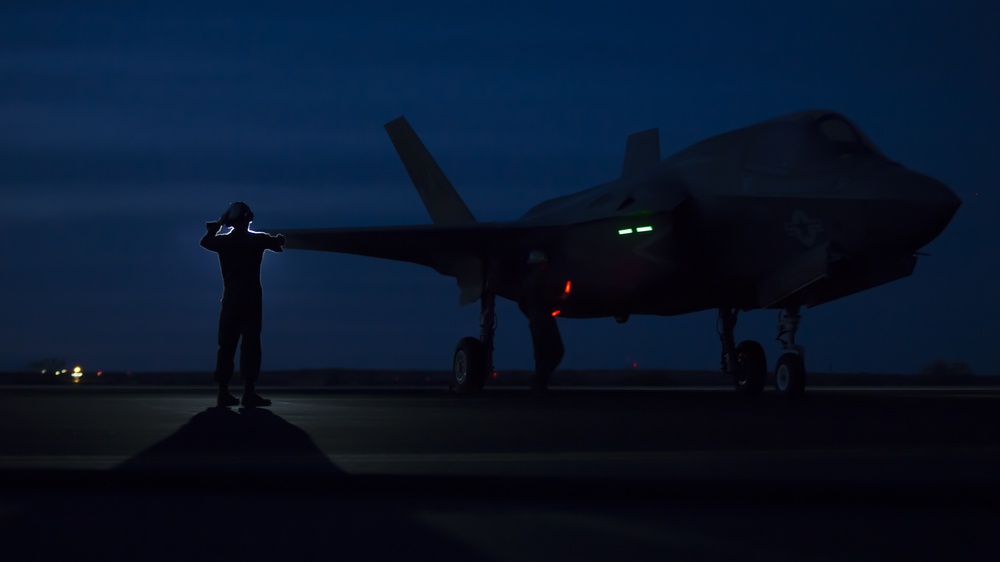
Photo By Staff Sgt. Ashley McLaughlin | A U.S. Marine with Marine Aviation Weapons and Tactics Squadron 1 communicates with an F-35 Lightning II pilot while a U.S. Marine condusts a preflight check during a Distributed Short Takeoff Vertical Landing Operation in support of Weapons and Tactics Instructor course 2-18 at Marine Corps Air Station Yuma, Ariz., March 30. WTI is a seven-week training event hosted by MAWTS-1 cadre, which emphasizes operational integration of the six functions of Marine Corps aviation in support of a Marine Air Ground Task Force and provides standardized advanced tactical training and certification of unit instructor qualifications to support Marine Aviation Training and Readiness and assists in developing and employing aviation weapons and tactics. (U.S. Marine Corps photo by Lance Cpl. Ashley McLaughlin/Released) see less
| View Image Page
MARINE CORPS AIR STATION YUMA, ARIZONA, UNITED STATES
Marines from multiple units conducted Distributed Short take-off vertical landing Operations with the F-35B Lightning II in support Weapons and Tactics Instructor course at Laguna Airfield, Yuma, Ariz., March 30.
This evolution incorporated multiple aircraft being fueled and armed at the same time. This is the first time in Marine Corps history two F-35B Lightning IIs have been hot loaded and then simultaneously fueled in a DSO setting.
“This is an extremely important event because we are validating this [DSO] at the aircraft’s infancy,” said Master Sgt. Jason Daniels, the Marine Aviation Weapons and Tactics Squadron 1 ordnance chief. “It took nearly 30 years to receive approval for F-18/A Hornet DSO. We are negating that problem and giving the [hot load] capability to the F-35/B right off the bat.”
Providing a hot fuel and hot load for multiple aircraft gives pilots the ability to stay in the fight longer, and accomplish more missions in a shorter period of time.
“A hot [fuel] and load allows the munitions to be prepped and ready to be loaded,” said Daniels. “As soon as the jet lands, you’re pushing the munitions under the aircraft. The aircraft can then get fuel and be pushed out to get back into the fight.”
After the F-35B Lightning IIs are guided into position, ordnance Marines load the bombs and refuel the aircraft. From there the aircraft re-fuel and take-off to complete the next mission.
Distributed STOVL Operations maximize the capabilities of STOVL aircraft and expand basing options due to reduced runway requirements.
DSO allows facilitates a tactical advantage by increasing operational reach, increasing capacity, distributing risk in anti-access area denial environments and capitalizes on flexibility and surprise.

 Subscribe






