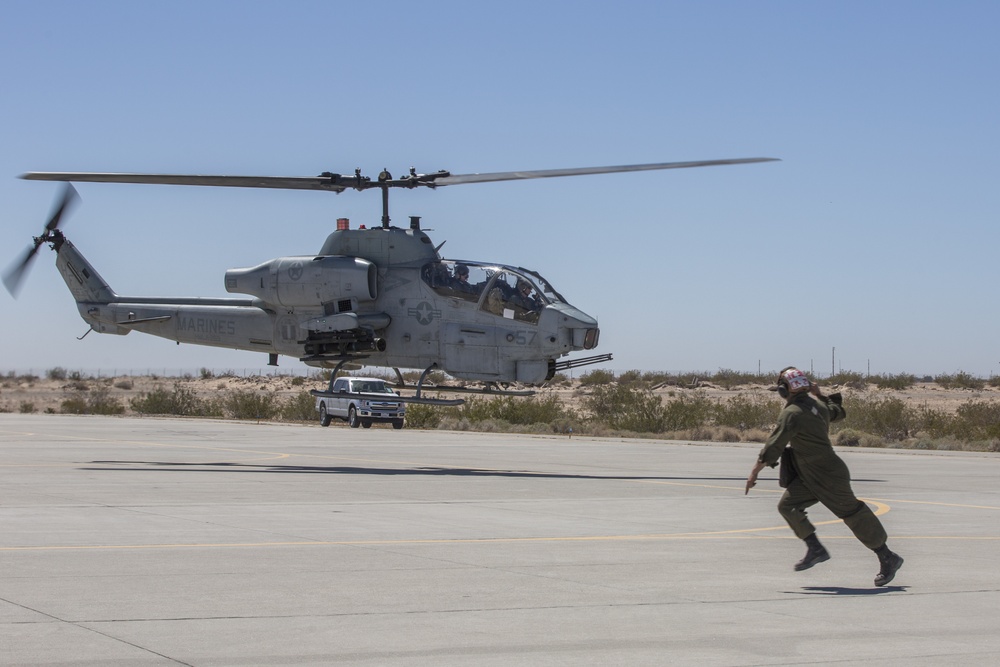
Photo By Staff Sgt. Ashley McLaughlin | U.S. Marine Corps AH-1W Super Cobra assigned to Marine Aviation Weapons and Tactics Squadron 1 receieves the all clear for takeoff during an Advanced Precision Kill Weapon System loading and flight takeoff exercise in support of Weapons and Tactics Instructor course 2-18 at Marine Corps Air Station Yuma, Ariz., March 29. WTI is a seven-week training event hosted by MAWTS-1 cadre, which emphasizes operational integration of the six functions of Marine Corps aviation in support of a Marine Air Ground Task Force and provides standardized advanced tactical training and certification of unit instructor qualifications to support Marine Aviation Training and Readiness and assists in developing and employing aviation weapons and tactics. (U.S. Marine Corps photo by Lance Cpl. Ashley McLaughlin/Released) see less
| View Image Page
MARINE CORPS AIR STATION YUMA, ARIZONA, UNITED STATES
U.S. Marines assigned to Marine Aviation Weapons and Tactics Squadron One built 2.75-inch rockets configured with Advanced Precision Kill Weapon System II during ordnance building training.
The training runs within Weapons and Tactics Instructor course, a seven-week training event hosted by MAWTS-1 cadre at Marine Corps Air Station Yuma, Ariz., March 28.
“APKWS II convert is an unguided Hydra 70 rocket into a highly accurate Precision Guided Munition,” said Staff Sgt. David Braga, a MAWTS-1 ammunition stock recording system munitions chief. “The smaller warhead greatly reduces collateral damage while providing sufficient lethality to destroy point targets.”
The rockets have three main sections; a Hydra 70 rocket motor, an M282 High Explosive Incendiary Multipurpose Penetrator Warhead and the guidance unit. The guidance unit allows for the change of the course of fire or hit moving targets.
“The APKWS II adds a mid-body Semi-Active Laser WGU-59/B guidance unit to the current 2.75-inch rocket,” said U.S. Marine Staff Sgt. Kendall Ripp, a MAWTS-1 aviation ordnance systems technician.
The guidance section and warhead size provides combat commanders with the ability to strike targets in close proximity to friendly forces safely along with lowering the amount of collateral damage, according to Braga.
“The 2.75-inch rocket with APKWS II guidance section and M282 Multipurpose Penetrator warhead is replacing the standard 5.0 inch high explosive warhead,” said Ripp. “This allows pilots to carry more of a payload per aircraft as well as creates a more accurate weapon.”
Giving pilots the capability to carry a higher quantity of weapons with improved accuracy allows Marines more rockets to train with and provides air support to troops on the ground.
“APKWS II provides the operational forces with the familiarity and employment training that is needed to understand and overcome any issues or differences they may encounter between other weapon systems.” said Braga. “This allows the APKWS II weapon system to be assembled and employed efficiently in a war time environment.”

 Subscribe






