By Anishka Calder
1st Sustainment Command (Theater)
Public Affairs Office
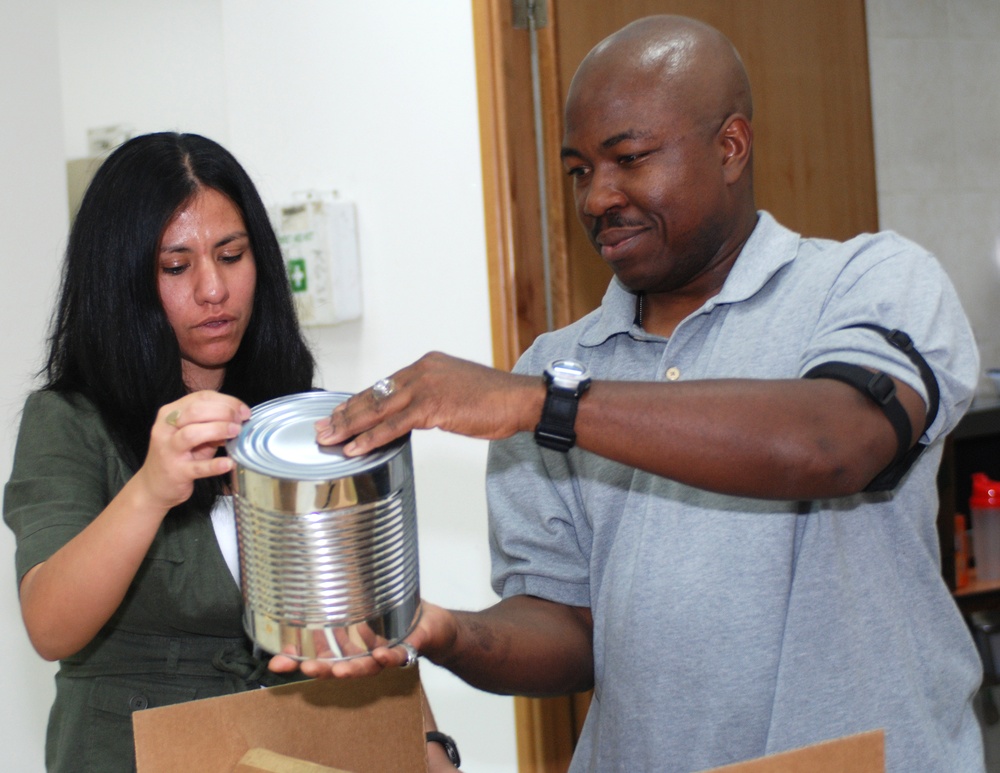
CAMP ARIFJAN, Kuwait – The forks on the forklift drop, and a pallet full of boxes hits the ground with a loud thump! The pallet is pushed into a side room, and the doors leading from the 18, 000 square feet warehouse closed, and Soldiers from the 422nd Medical Detachment—Veterinary Services, a reserve unit out of Rockville, Md., ripped into the boxes of unitized group rations.
Their job is to ensure that food being served to the service members and civilians assigned to the central command area of responsibility conforms to Department of Defense safety standards.
The Soldiers go through a rigorous process of checking these food items which not only come from the United States, but also from the local economy and surrounding countries. These foods are placed into three categories: government furnished materials, such as energy bars and drinks; operational rations, which include UGRs, meals ready to eat, Halal and Kosher meals; and prime vendor or local market-ready items such as fresh fruits and vegetables, said Staff Sgt. Linwood D. Pender, 37, the non-commissioned officer in charge of food inspections from the 422nd Medical Detachment—Veterinary Services.
"Basically all these fruits and vegetables come from different regions, depending on the growing season," Pender said. "The Army has purchase specifications for the contracts of those fruits and vegetables, as well as the meats and operational rations. It's part of our job to ensure that the companies or vendors that are providing these materials, are providing (what) the contracts states. From time to time we also go out and do audits at the vendors who we purchase from, to ensure that those who are producing products conform to military regulations, and that those who are storing products, do so properly."
Each time the warehouse receives an item in its stock, the civilian workers there have to annotate what the item is and its expiration date.
"As those items become closer to their expiration date, especially if they are 36 days or less, we take a look at these products to possibly extend these products for another three or six months," said Pender, a native of Laurel, Md.
The reason for the extension is to make sure that from the date the food inspectors look at them, these items have ample time to make it to its destination and to possibly be stored for a short time at the dining facility, and then be served to the Soldiers, Pender said.
The six-man team examines between $500, 000 to over a $1 million worth of food products on a weekly basis, Pender said. While an important aspect of the food inspectors' job is to ensure that the Soldiers are given quality meals to consume, one of the most important reasons for inspecting the food supply is ensuring the safety of those who consume it.
"I feel like I pull security within the transport of the food to make sure that from the time it leaves the factory or the storage area and goes out to the troops, that it's not tampered with," said Pender. "We have to make sure that the safety of the Soldiers or their mission is not jeopardized. Tampering or poisoning a truck load of food does not affect just one Soldier, it could affect an entire battalion of Soldiers and pose a problem to the unit's mission."
Spc. Victor Rivera, 27, a veterinary food inspection specialist from the 422nd Medical Detachment—Veterinary Services, echoed similar sentiments.
"It's not just about looking at food and making sure that it is wholesome, we are also trained in food security and we check to make sure that the food hasn't been tampered with," said Rivera, a native of Chesapeake, Va. "If someone's tampering with our food before it gets out to those Soldiers, it will affect the overall mission." He said that they check the storage and packaging conditions of the food, and check the food to make sure they haven't been tampered with.
After inspectors sample a product and there's nothing wrong with it, the contents are placed back into the box, sealed, and is sent back to the warehouse to be re-issued. If it's perishable, such as frozen products, it's destroyed because once the product is thawed out, it starts degrading, said Spc. Marcus Bailey, 26, a veterinary food inspection specialist from the 422nd Medical Detachment—Veterinary Services.
If a defect is found, a special inspection is conducted to find out the nature of the problem. Samples are pulled and tested, and a decision is made whether to destroy the product, use it as first issue, or to keep the product as is and see what happens, said Bailey. Usually, they go with the worst case scenario, and the product is destroyed.
Aside from checking the food to ensure the safety of the service members who consume it, the food inspectors also do food recalls and ensure that the government gets what they are paying for in terms of quality and quantity, Bailey said.
"If we are forced to purchase less than perfect quality items, then we make sure that the government gets the appropriate discount," said Bailey, a native of Salisbury, Md. "We also make sure that what the Soldiers buy in the Army and Air Force Exchange Services while deployed, is equivalent to their money's worth. For example, if you are paying $1.50 for popcorn, we make sure you are getting $1.50 worth of popcorn."
The work of the food inspectors is an on-going one. As long as there is a threat to service members who serve at home or in deployed areas, whether it be food-borne illnesses or acts of terrorism through food, food inspectors will be there working behind the scenes to safeguard the lives of service members.
"It's a good feeling knowing that we are doing this for our country," said Rivera, a six-year veteran. "But not only that ... , it's about helping those on the frontlines in Iraq and Afghanistan doing the big jobs, doing the convoys, getting in fire fights and going out there conducting raids. What we do here may make their day a little better when they get this food. When it comes down to it, it's all about them."
| Date Taken: |
11.26.2007 |
| Date Posted: |
11.26.2007 13:55 |
| Story ID: |
14129 |
| Location: |
CAMP ARIFJAN, KW |
| Web Views: |
677 |
| Downloads: |
430 |
PUBLIC DOMAIN

This work, Feeding the forces—food inspectors and their contributions, by SFC Anishka Calder, identified by DVIDS, must comply with the restrictions shown on https://www.dvidshub.net/about/copyright.

 Subscribe






