Sgt. Kevin Stabinsky
2nd Brigade Combat Team, 3rd Infantry Division
FORWARD OPERATING BASE KALSU, Iraq – Senior leaders from both the government of Iraq and United States Army came to visit Soldiers at Patrol Base Hawkes, Oct. 27, to get an assessment from troops on the ground.
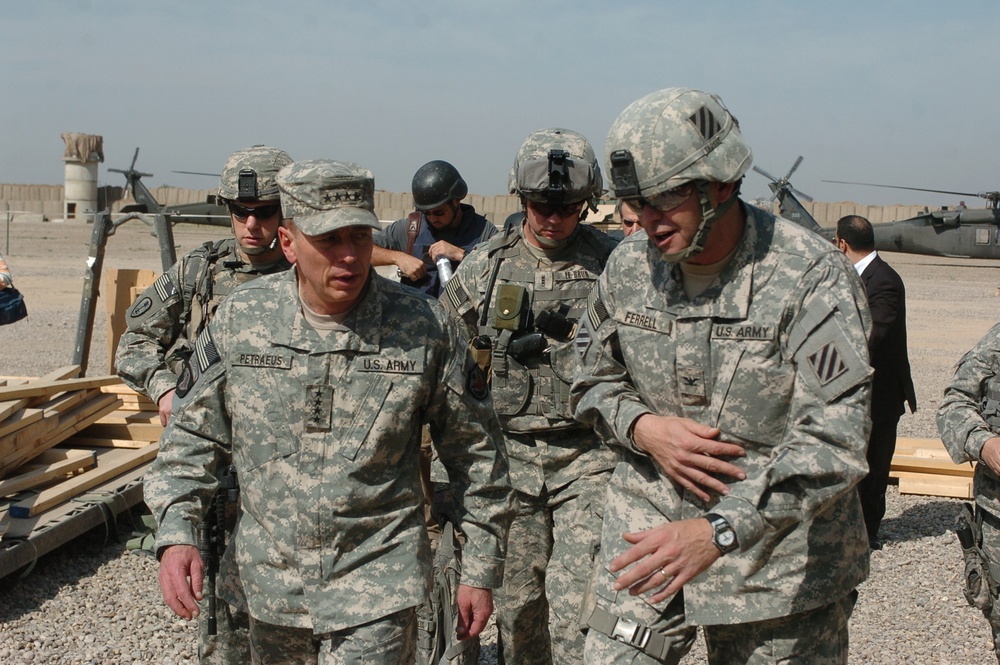
Gen. David Petraeus, commanding general, Multi-National Force-Iraq, Dr. Ahmad Chalabi, director of services in Iraq, and Dr. Safi Al-Sheik, director of the Iraqi national reconciliation committee, met with Soldiers and leaders of the 1st Battalion, 30th Infantry Regiment, 2nd Brigade Combat Team, 3rd Infantry Division, Fort Stewart, Ga., who are operating in the Arab Jabour area.
Col. Steve Boylan, a spokesman for Petraeus, said the visit was meant to provide the leaders a better view for what Soldiers on the ground are experiencing as they implement Petraeus' counter-insurgency strategy. Petraeus is the author of the Army counter-insurgency operations manual, FMI 3-07.22.
"You can only gain so much from reports," Boylan said.
The three supplemented their knowledge on the ground with face-to-face talks with Lt. Col. Ken Adgie, 1-30th battalion commander, and Col. Terry Ferrell, 2nd BCT commander.
"It's been hard, but it has worked," said Adgie, of Petraeus' counter-insurgency plan. Comparing it to a drop of oil in water, Adgie said the drop, once small, has spread.
Arab Jabour was a safe haven for al-Qaida before the 2nd BCT entered the area; no coalition presence or Iraqi security forces had been there since the conflict began over four years ago.
However, Adgie said the tide is turning, crediting in part the concerned local citizens in the area, who now number 699.
The program, in which local citizens act as security for their neighborhoods, has helped push al-Qaida from the area. Retired Iraqi army Brig. Gen. Mustafa Kamel helped to form the CLC program in Arab Jabour.
"Gen. Mustafa has given the people hope," Adgie said, describing the concerned citizens as "braver than the brave."
Displaced citizens are beginning to return to the area, bringing back specialists like doctors and engineers, Adgie said.
Water pumps are also being repaired, an important development because the people of Arab Jabour are primarily farmers, depending on pumps transporting water from the Tigris River for irrigation.
Adgie said he will continue to expand on these successes as the focus changes from security to reconstruction, an important part of Petraeus' counter-insurgency policy.
Petraeus pointed out similar successes exhibited in the Anbar province and the former "Triangle of Death," which he now calls the "Circle of Life."
As Arab Jabour experiences a rebirth, an important step is involving the Iraqi central government.
"How do we connect the dots between pieces of the government?" Adgie asked. "They are smart guys (the leaders in Arab Jabour). They just need some help."
The Iraqi government has been reluctant in offering this help to Arab Jabour and other the predominantly Sunni-based areas for fear that the CLCs will turn into anti-government militias.
To help alleviate this fear, Adgie said the CLCs will transition into a police force for the area. Two hundred fifty-eight have volunteered to become police officers, more than double the 120 Adgie believes would be needed to police the area.
The measure of incorporating the CLCs into Iraqi security forces is necessary to enable them to stand up on their own once American forces transition from combat roles to more advisory roles.
"We made a lot of good friends," Adgie said. "We refuse to let al-Qaida back in."
Keeping al-Qaida out is a priority, Ferrell said, now that operations are being geared toward reconstruction in Arab Jabour.
Toward that end, a Provincial Reconstruction Team was added to the 2nd BCT at the beginning of October.
The team is already working to restore such basic infrastructure such as clinics, schools and fresh drinking water, Ferrell said, noting that about $1.9 million in commander's emergency relief program funds was available to contractors in the area.
One pressing need is local health care facilities; Arab Jabour residents can only get health care by traveling to Baghdad.
Hearing Adgie and Ferrell's comments and concerns, Chalabi said he would speak with the minister of health about getting the government involved in the area.
Chalabi said he would also work with the ministry of water to help with the repair of a sewage treatment facility.
The facility, currently inoperable, is repairable. Once repaired, the facility can provide 200 jobs and help relieve sewage problems in the outskirts of Baghdad.
Before leaving, Petraeus recognized one Soldier from each of the 1-30th Inf. Regt.'s seven companies by presenting them with a commander's coin of excellence. Soldiers on their third tour of duty were also awarded with a coin.
| Date Taken: |
10.30.2007 |
| Date Posted: |
10.30.2007 10:30 |
| Story ID: |
13470 |
| Location: |
ISKANDARIYAH, IQ |
| Web Views: |
541 |
| Downloads: |
402 |
PUBLIC DOMAIN

This work, Petraeus gets feedback from surge troops, by SGT Kevin Stabinsky, identified by DVIDS, must comply with the restrictions shown on https://www.dvidshub.net/about/copyright.

 Subscribe





