
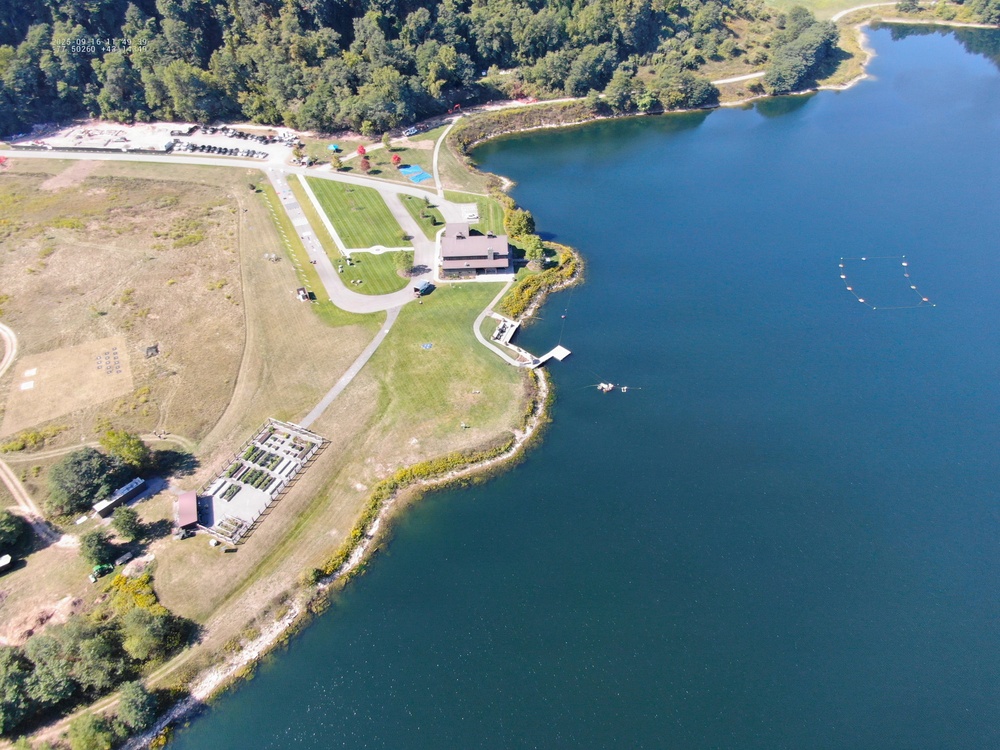
The U.S. Naval Research Laboratory (NRL) launched a groundbreaking remote sensing experiment, Coastal Hyperspectral Reflectance Object Material Analysis (CHROMA), Sept. 4-19, 2025, designed to accelerate the application of artificial intelligence (AI) in hyperspectral imaging and strengthen environmental intelligence and resource management capabilities across the Department of War and the wider scientific community. A bird's-eye view from an RIT drone shows the Rochester Institute of Technology’s Open Community eXperiment (ROCX) experiment site. The rock sample arrays are visible on land (left-middle portion of the photo), while the coated panels float on the water (upper-right), allowing for simultaneous data collection in a real aquatic-land environment. The photo also shows various other targets belonging to industry and academic participants in the ROCX. (Photo by Timothy Bauch and Nina Raqueno, Rochester Institute of Technology)
| Date Taken: | 09.16.2025 |
| Date Posted: | 01.07.2026 10:26 |
| Photo ID: | 9469958 |
| VIRIN: | 250916-O-GC727-4099 |
| Resolution: | 4000x3000 |
| Size: | 3.59 MB |
| Location: | NEW YORK, US |
| Web Views: | 49 |
| Downloads: | 2 |

This work, Naval Research Lab Sharpens Navy’s Sights with a Domain-Centric Path for Smarter Sensing [Image 5 of 5], by Nicholas Pasquini, identified by DVIDS, must comply with the restrictions shown on https://www.dvidshub.net/about/copyright.


Naval Research Lab Sharpens Navy’s Sights with a Domain-Centric Path for Smarter Sensing
No keywords found.





