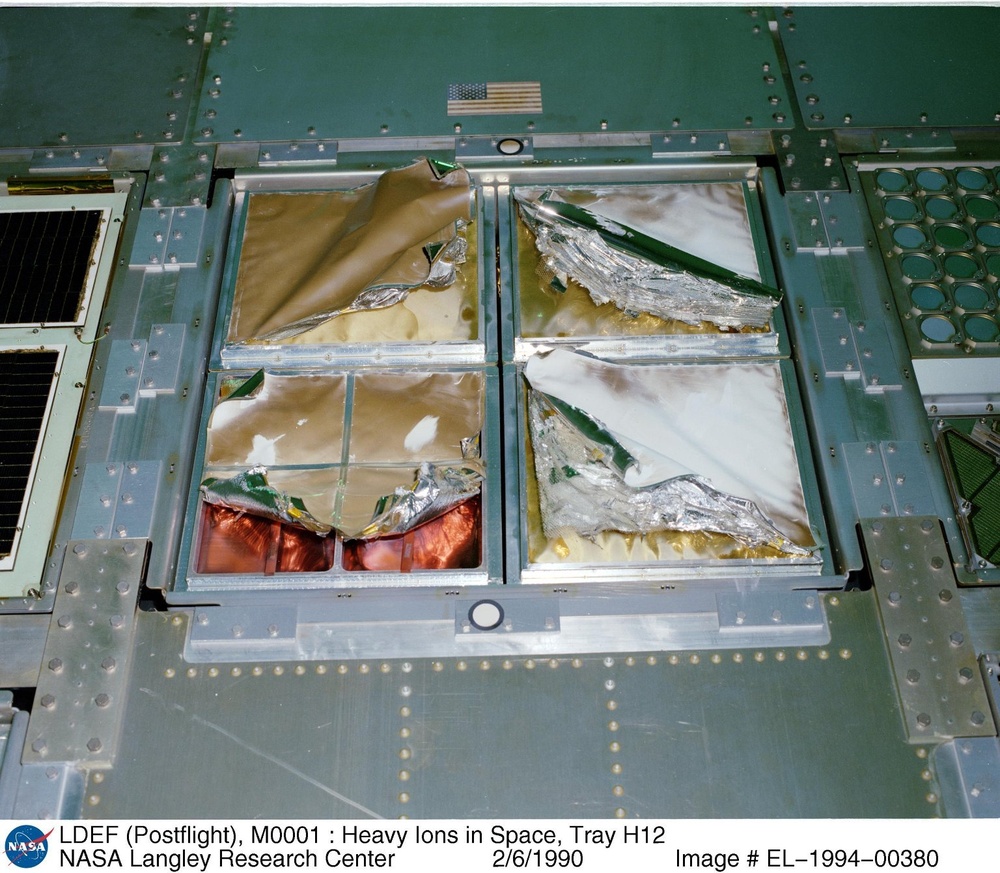
The postflight photograph of the Heavy Ions in Space Experiment was taken prior to the experiment being removed from the LDEF structure. The experiment's damaged multi-layer thermal insulation blankets were removed from the exper- iment, so the experiment tray cover could be installed, prior to removing the experiment from the LDEF The Postflight photograph shows the four (4) experiment modules with multilayer thermal blankets that are severely degraded. Paint on the top layer, previously white, is now a glossy soft brown or tan color. The thermal blankets apparently shrunk in flight causing them to detach from the modules frame along two sides, thereby relieving the tension buildup. The tape used to attach the blanket to the structure failed in tension across the width of the tape leaving portions of the tape on both the frame and the top layer of the thermal blanket. The thermal blankets on the three (3) large modules have curled to expose the top Lexan layer of the detector stack beneath. The curled thermal blankets that protected the four (4) smaller modules now exposes the 5 mil aluminized Kapton pressure covers beneath. The damaged thermal blankets shown in the two (2) tray quadrants on the right side of the photograph reveal representative cross sections of the multilayer thermal blankets. The thermal blankets top layer is a 5 mil aluminized Kapton film with an exterior overcoat of Chemglaze II A-276 white paint. The blanket core, center section of the blanket, is constructed of approximately twenty two (22) layers of 1/4 mil perforated Mylar film with aluminum vapor deposited on each side. A Dacron mesh separator, clearly seen in the lower right quadrant, is placed between each aluminized Mylar layer of the core material and also between the core material and the aluminized Kapton film used for the thermal blanket top and bottom covers. Insertion of the Dacron mesh between the aluminized layers minimizes heat leaks within the thermal blanket.