The following quote is from 9th Century Roman Emperor Charlemagne, translated into Spanish.
“Tener otro idioma es de poseer una segunda alma.” In English, it reads: “To have another language is to possess another soul.”
To understand that quote in both languages means more than possessing two souls. It can also mean the ability to bridge the barrier between people, countries and, sometimes, armies.
That is what soldiers of the 223rd Military Intelligence Battalion, California Army National Guard, are doing as linguists in El Salvador.
“It’s not as easy as people think,” said Spc. Charles Chang, of the 223rd.
Chang put his translating abilities to the test last month during the opening ceremony of Beyond the Horizon 2011, a training exercise to provide humanitarian assistance to the people of El Salvador most affected by Hurricane Ida in 2009.
When journalists pushed soldiers standing in formation and stormed the stage of the ceremony, just as U.S. Ambassador Mari Carmen Aponti began speaking to the audience, Chang had to regulate the group in Spanish.
“I kept telling them (in Spanish), ‘You can take pictures in the designated area but you can’t walk through formations shoving soldiers to the side,’” said Chang, who eventually got the journalists to stop walking through formations.
Chang, as well as other linguists, takes the Defense Language Proficiency Test each year to remain qualified in Spanish. Test-takers must score a two out of three in reading and listening portions. The test is multiple choice and scorers can score higher than three on the advanced scale.
For Chang, deploying to foreign countries as a linguist is nothing new. Last year he was in Nicaragua. In 2009 he was in the Dominican Republic.
“I grew up in a household with many different languages. That’s why this job is perfect for me,” said Chang, who learned Spanish from his mother and Chinese from his father.
Staff Sgt. Adrian Bustos, of the 223rd, is also deployed to Central America. He is serving as the permanent party linguist for Beyond the Horizon 2011 and is here until mid-June.
For the majority of the exercise, Bustos has had little difficulty translating between English and Spanish speakers. Bustos worked as the translator when Brig. Gen. Cesar Adonay Acosta Bonilla, the Salvadoran Chief of Staff, visited the forward operating base Monday. He also has sat in on several battle update briefs as the translator for Salvadoran officers.
Bustos, who grew up in a Spanish speaking household outside Fresno in Visalia, Calif., has handled the pressure that comes with being a linguist.
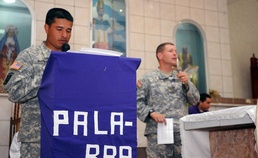
His most difficult situation came earlier this month when he translated in front of a congregation of more than 150 in a rural Salvadoran church named Parroquia de San Ildefonso. When Chaplain Maj. Wes Balmer visited to inform the congregation on the medical and dental assistance available during the exercise, Balmer finished his speech with ad-lib, diverting from what Bustos was expecting.
“English and Spanish speakers who don’t speak another language tend to think that all you are doing is taking words and replacing them in sentences, but there is much more to it than that,” Bustos said. “Grammar plays a huge role and the majority of words don’t have definitive replacements.”
Bustos paused and recovered to spread the message of the exercise to the congregation.
“The linguists have really done a great job here for the exercise,” said Col. Timothy Houser, 130th Maneuver Enhancement Brigade commander, which serves as the command and control element for the exercise until its conclusion in June. “Without them we aren’t able to continue. It’s that simple. We need them to perform this exercise.”