CONTINGENCY OPERATING BASE ADDER, Iraq — Because of an expedited construction schedule and a joint military and civilian effort, operations for a part of the infrastructure enabling the upcoming responsible drawdown of troops and equipment from southern Iraq began this month, almost an entire year ahead of schedule.
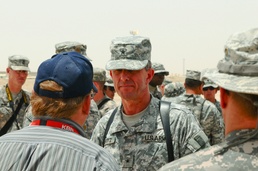
Lt. Gen. Kenneth Hunzeker, deputy commanding general for support, United States Forces – Iraq and a Pittsburgh native; Brig. Gen. Paul L. Wentz, commanding general, 13th Sustainment Command, and a Mansfield, Ohio native; and Col. Sean Ryan, commander of the 36th Sustainment Brigade, 13th ESC, and a Cedar Park, Texas, native, cut a ceremonial ribbon May 27 signifying the completion of construction at a tactical theater fuel farm at Combat Support Center Adder, Iraq.
The combat support center, housing an 8 million-gallon capacity facility for petroleum products, is adjacent to Contingency Operating Base Adder, Iraq. The primary contractor for the project was KBR, Inc.
The task is being undertaken to replace the fuel capacity at Contingency Operating Base Cedar, Iraq, in a coordinated transition of mission responsibilities said Capt. Smiley Garcia, petroleum supply officer with the 36th Sust. Bde. and an Austin, Texas native..
The consolidated facility at CSC Adder is the largest of its kind. The construction project was completed by the 36th Sust. Bde. in partnership with KBR, Garcia said.
"We have the largest operating military tactical fuel farm in the world," he said. "This, of course, is a massive undertaking; a joint military and civilian partnership to make this project executable."
Garcia said the enormous project took place over three separate phases.
"The first phase, completed in December, [was] the automotive gasoline berm," he said. "Then we went into construction of the diesel berm, finished around February, and finally our largest commodity, JP8 fuel, and the largest construction phase was completed in March."
Garcia described how the enterprise began operations and said the end project was a combination of shifting infrastructure and transportation assets.
"By May 15, we had all three phases of the project operational, consolidating all of the incoming convoys from Kuwait and consolidating all of the outgoing transportation assets as well," he said.
Wentz described the importance of the fuel farm in terms of the transition of sustainment operations in Iraq and the consolidation of sustainment sites.
"This is the theater's main storage capacity," he said. "It really allows us to draw down other sites and have the capacity on hand to meet fuel demands in other places where we have 'de-scoped.' This project will allow us the capacity to support day-to-day operations and fuel the responsible drawdown."
Wentz emphasized the significance of the theater fuel farm opening within the framework of the overall transition of the U.S. military presence in Iraq.
"It's a big event, historic … in the story of the drawdown [from] Iraq," he said. "It's a great day — one day closer to us actually leaving Iraq, and turning all this over to the Iraqis."