By Spc. Nathan Hale
145th Mobile Public Affairs Detachment
CONTINGENCY OPERATING BASE SPEICHER, Iraq — There is a small but important group of soldiers at United States Division - North who are trained to diverge from the normal school of military thought. These soldiers, known simply as Red Team, make up a specialized staff, who provides critical decision-making and analysis based on the modern battlefield.
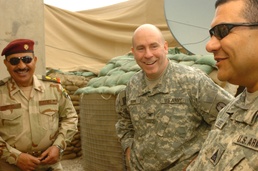
Their leader is Col. Malcolm S. Burr II of Georgetown, Mass., a U.S. Army Reserve officer with 26 years of commissioned service. His team works in conjunction with the division staff, but is not a part of it. The team scours plans and operations to provide optional solutions which take into account not only local culture and customs but also what the enemy may try to do to counter the operations.
Burr said that the Red Team used to give a different perspective in a time where unconventional warfare is the norm.
"If we integrated into another staff section, such as plans or operations, we might tend to blindly agree with everything that office comes up with," said Burr, who operates on Contingency Operating Base Speicher near Tikrit. "As an independent office, we can look at things a little differently."
For a Red Team, Burr said it takes time and effort for units to properly understand its role
"Red Teams are not an instant thing, it's more of an art," he said. "We're decision support, so we try to fill in a staff and ask, 'Okay have you looked at it this way? Well, we see this, do you agree with us?' Then you get into a dialogue, some collaboration. Those relationships take time."
He said he has heard the term "devil's advocate" used to describe what red teaming is all about. However, he believes the phrase works against his team as well.
"If we go into a senior-level meeting and everybody thinks our ideas are just playing the other side, we might not be able to get our position across because they will discredit us from the beginning," he said. "Instead we listen, provide in-depth analysis of the subject matter and present our ideas. The red team can get away from the situation and ask, 'Well, why do we keep going down this path?'"
Red Teams are becoming the norm at many staff units, according to Burr, and their range of expertise and understanding is becoming an asset for the Army.
Burr's previous experience as an embedded Iraqi army advisor in Fallujah, 2004-2005, has enabled him to more accurately understand what Iraqi military and civilians perceive. Other Red Team members entered theatre with varied backgrounds, including agricultural, farming, business, industry, computer, information operations, aviation, in addition to attending the University of Foreign Military and Cultural Studies.
One of the ideas the team came up with was to have a database of soldiers with their skills, which may not be properly utilized. For example, if there is a project in northern Iraq to help Iraqi farmers, this database will show soldiers who are capable of farming and can help on the project.
They often conduct field work with military and border transition teams, their Iraqi counterparts and the civilian populous. Those working relationships give the team the ability to distinguish between reality and perception. It is also crucial that the team has familiarity with all current activities and are able to quickly pinpoint concerns with current and future planning gaps and seams.
According to Burr, Red Teams are quickly becoming an integral part of staff-level units. Even then, the team's ideas aren't always accepted at first.
"If they don't like what we present, we will continue to brainstorm, refine and repackage the idea and try again," Burr said. "We just want to make sure nothing is missed and everything is taken into account."
During his time at the leader's course — which runs 18 weeks at the University of Foreign Military and Cultural Studies at Fort Leavenworth, Kan. — Burr attended a practical exercise during which he helped with the planning of the 25th Infantry Division's mission readiness exercise at Schofield Barracks, Hawaii. An MRX is a military exercise designed to represent a deploying unit's mission in the theater of operations. Burr said the Division had not had a Red Team in the past which meant he had to work to break the ice.
"At first staffers didn't really understand what we did," he said. "We worked hard to build relationships with the other sections. We were each going to up to 10 meetings per week in the beginning."
Just as his team had to build relationships within the Division, Burr believes one of the important challenges for incoming units is to quickly build relations with their Iraqi counterparts.
An example "We have worked on a plan to have incoming units spend more time engaging with local Iraqi leaders and their Iraqi counterparts in their areas of operation during the transfer process," said Burr. "The outgoing units have spent sometimes up to a year developing relations with Iraqi's and their exiting often creates relationship cracks that have to be rebuilt from the ground up."
The idea is to get the outgoing units to facilitate this process so the progress isn't lost each time a unit is replaced.
"It goes a long way if we can get the new units out working with their Iraqi counterparts and Iraqi leaders as soon as possible," he said.
Burr said his experience working with the 25th Inf. Div. and now the 3rd Inf. Div., from Fort Stewart, Ga., has been fulfilling.
"The leadership and all the staff of the divisions are very professional and knowledgeable," he said. "Now when they see us in their meetings, they know we will listen to them and give them our in-depth analyst and feedback on the subject."
Burr will continue to serve as the Red Team leader for USD-N through Jan. A new team with new ideas and concepts replace Burr and his team. After returning home Burr will said he plans to write a book about his views on the current military, society and other thoughts on the modern world.