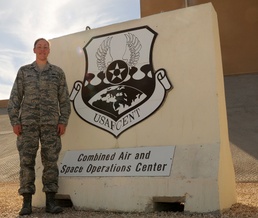
SOUTHWEST ASIA – The holidays are a time of year for family and friends, but one Louisville native instead spent it making sure key military leaders have the data they need to conduct current operations in Southwest Asia.
Capt. Susan Keely is an analyst with the U.S. Air Force’s Combined Air and Space Operations Center Operational Assessment team and helps collect, analyze and translate essential information for key decision makers throughout the U.S. Air Force Central Command area of responsibility.
The division provides analysis on short- and long-term priorities as determined by Lt. Gen. David Goldfein, the Combined Forces Air Component commander. Other commanders in the AOR also use the information, analysis and predictive assessments the OAT provides to aide in critical decision making.
“Our main priority is to support the CFACC and other general officers with their requests for information or analysis,” said Lt. Col. Chris Cullenbine, the OAT chief.
There is no limit in the types of data the OAT can collect and analyze. Examples of important information they’ve provided include metrics on casualties in relation to kinetic events; weapons systems; intelligence, surveillance and reconnaissance efforts; and combat aircraft sorties.
When a special request comes in, an OAT analyst will begin the research process of the subject. The team calls these requests science projects. The projects can be simple requests for additional information or in-depth research on a specific subject. Through coordination with subject matter experts and using their research tools, the OAT can break down the data, track trends from previous research and compare results with other projects to provide the comprehensive analysis needed.
“We are able to provide unbiased analysis of data because we have access to a lot of resources,” Keely said. “We can marry that data together and provide the important information needed.”
Keely joined the Air Force to follow in her sister’s footsteps. She said she was enticed by the benefits that came with military service such as job security and education opportunities, and has grown to love the Air Force more than just the job security.
“I enjoy working with people motivated by their commitment to service and to protect our country,” she said.
After high school, Keely attended the U.S. Air Force Academy in Colorado Springs, Colo., and is currently stationed at Eglin Air Force Base, Fla.
She said her favorite part about her job is providing her leadership with analysis and seeing decisions made based on that analysis. The goal of the team is to improve Air Force operations throughout the AOR. In fact, the team is paving the way for future operations.
While ISAF transitions from a lead to support role in Afghanistan, many of OAT’s projects have been helpful to assist with the changes.
“We have been able to track activity on the [transition] to help show how our security forces are passing responsibilities to the [Afghan National Security Forces],” said Maj. David Mills, an OAT analyst.
Their research and analysis aid decisions on such things as how to apportion limited resources to maximize air support to the ground commanders or whether or not to change techniques for IED searches. As analysts from very different bases and missions throughout the Air Force, the members of OAT are able to come together with the collective objective of supporting the AOR missions with their analytical skills.