GERMANY - A great way to gain a wider perspective on tactics and skills that must be had in order to overcome obstacles and challenges on today’s modern battlefield could be to train with military forces from other countries.
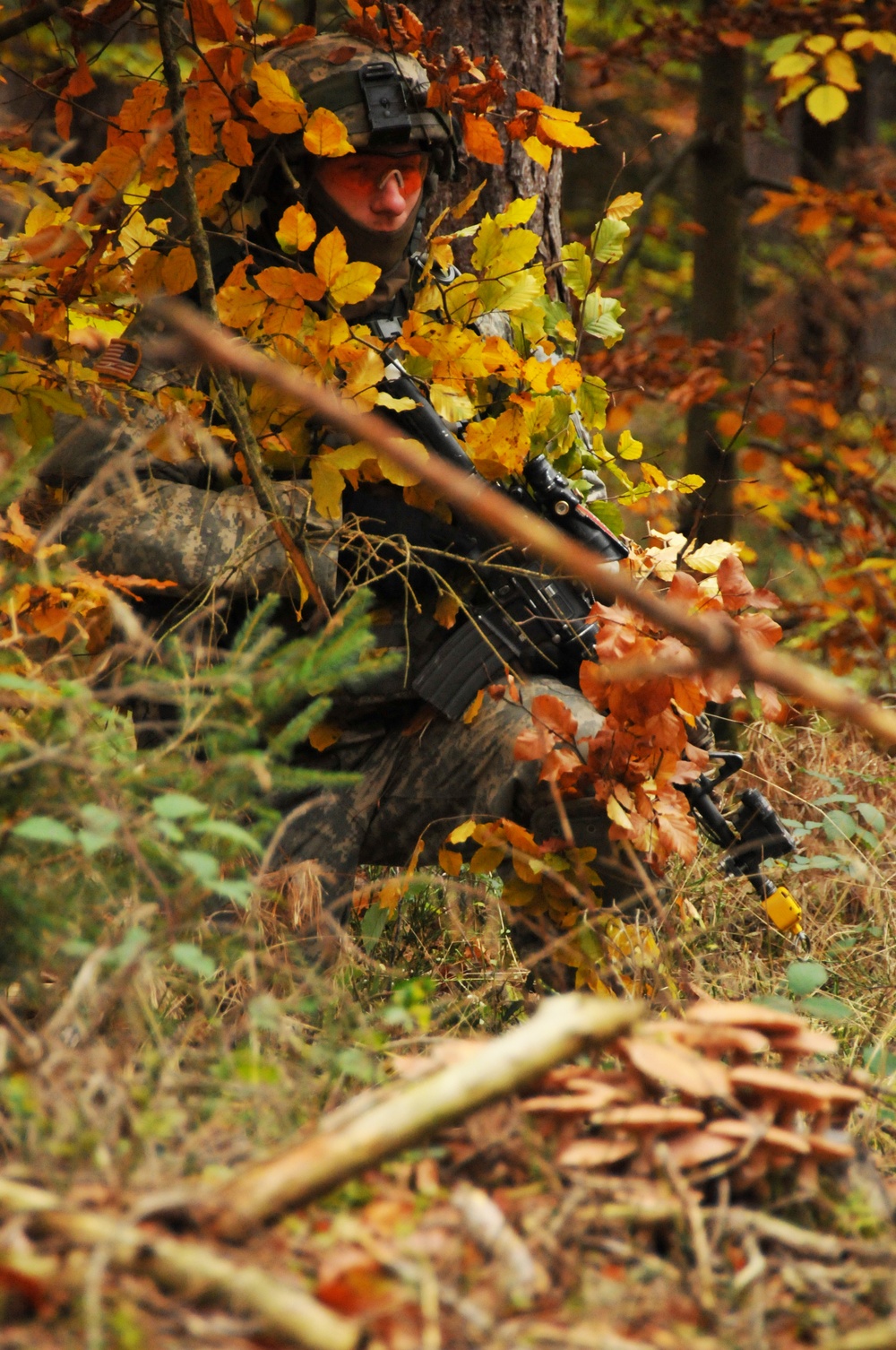
The 2nd Cavalry Regiment and other units with U.S. Army Europe participated in a Decisive Action Training Environment (D.A.T.E.) rotation with multinational partners Oct. 13 through the 31 between the Grafenwoehr and Hohenfels Training Areas.
The exercise, Saber Junction, had a maneuver-rights area that expanded approximately 2,200 square kilometers and hosted more than 3600 2CR troops and 1700 foreign military personnel from 18 countries which makes it the biggest training event of this type for USAREUR since 1989.
More than 10 million dollars was contributed by the U.S. Government to ensure the successful training of USAREUR troops and their partner nations.
Along with 2nd Cavalry Regiment, USAREUR units who participated included Europe’s 12th Combat Aviation Brigade, 172nd Infantry Brigade, 173rd Airborne Brigade Combat Team, 16th Combat Sustainment Brigade, 18th Military Police Brigade and 19th Battlefield Coordination Detachment from Ramstein Air Force Base.
Multinational partners who trained with USAREUR in Saber Junction included Belgium, Bosnia, Bulgaria, The Czech Republic, France, Germany, Italy, Latvia, Lithuania, Macedonia, Norway, Poland, Romania, Serbia, Slovenia, Sweden, The Ukraine and the United Kingdom.
During the exercise, Slovenian armed force teamed up with 2CR and contributed anti-air assets which were essential for the security of the coalition forces. This effort gave the Slovenians an opportunity to train in an unfamiliar environment.
“Without air defense some [damage] will happen to the command post, it is a high value target for the enemy,” said Capt. Bosan Leskovar, a Slovenian commander with the 9th Air Defense Battalion. “It’s a very good experience for us because our country is a small one and we know every position, so it’s a challenge for us because we don’t know the terrain. We must do a recon to find the best position [here].”
U.S. Army Capt. Joshua Frye, the provost marshal for 2CR and native of Blountville, Tenn., used his German-speaking skills to interact with the local population and talked about the effect this type of training had on the German population.
“The Germans have been so receptive to this whole exercise and I think it’s wonderful to see the little kids walk right up to the concertina wire with a big smile on their face and taking pictures, their minds are full of questions,” Frye said. “We are shaping a generation of Germans. They are getting used to seeing us out there and they know that we’re their neighbors.”
The opportunity to train outside the confines of a military base allowed U.S. and multinational troops to be exposed and adapt to real-life challenges they might encounter in a deployed environment including interaction with the local community, moving through unfamiliar terrain and maintaining battle rhythm safely while adhering to host country laws.
“It’s been really incredible, seeing all these different forces out here and maneuvering across such a large very diverse battlefield, I don’t think you could do this anywhere else,” Frye said. “We see partners from all sorts of other countries and it’s a really valuable experience.”
Sgt. Maj. of the Army (ret.) Kenneth O. Preston visited 2CR before the start of Saber Junction. The visit was an opportunity to get a look at the training from a senior-leader’s perspective.
“We have always had a close working relationship with our allied partners here and as I walk through and see the operations today, I see how that relationship has become much more refined,” Preston said. “I think that’s something all of us can be very proud of and it’s all part of our professional development.”
During the rotation Leskovar expressed his gratitude for being able to partner with U.S. forces for the training.
“It’s good experience to cooperate and train with U.S. troops and to see how they fight,” Leskovar said. “It was good to get a feel for how they work and move.”
Training with troops from countries other than their own, in a foreign country, creates a new learning environment for U.S. soldiers.
“The value of this training can’t be overestimated,” Frye said. “This is the most complex environment you can find yourself in and replicating that here in the middle of Bavaria is incredible after all these years.”
Frye explained the benefits of being able to train with multinational partners, not only for U.S. forces but other countries as well.
“Just the other day we had a group of Feldjäger, which are German military police, who made the long trip down to visit us out here in the field,” Frye said. “It was a morale booster for me and our military police and it was very valuable for them to see how we operate.”
| Date Taken: |
11.14.2012 |
| Date Posted: |
11.14.2012 08:08 |
| Story ID: |
97741 |
| Location: |
BADEN-WURTTEMBERG, DE |
| Web Views: |
164 |
| Downloads: |
0 |
PUBLIC DOMAIN

This work, US, multinational soldiers build interoperability at Saber Junction, by SGT Joshua Edwards, identified by DVIDS, must comply with the restrictions shown on https://www.dvidshub.net/about/copyright.

 Subscribe






