By Army Sgt. Charles Brice
102nd Mobile Public Affairs Detachment
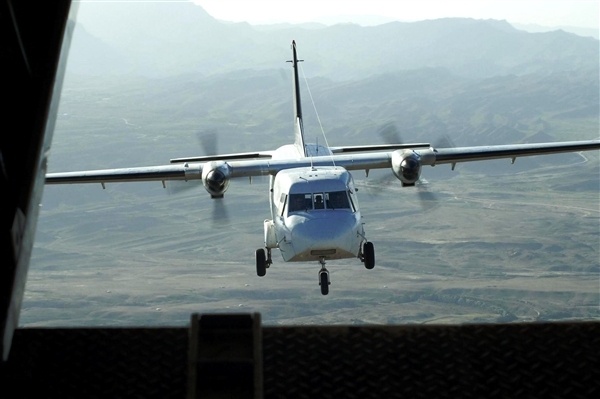
FORWARD OPERATING BASE SALERNO, Afghanistan - The jumpmaster stands in the back of a turbo-prop cargo airliner with a nervously rumbling stomach, holding on to a few pallets of supplies that soon would be dropped to soldiers in an isolated region of eastern Afghanistan. The flight doors begin to open, and the pilot performs jaw dropping maneuvers through the mountain valleys.
Members of the "speedball" aircrew say that's how it feels when a person steps into their world, the realm of low-cost, low-altitude aerial delivery services, or LCLA. The operations can resupply platoon sized units during missions when the means of normal sustainment delivery are impossible due to the factors of mission, enemy, terrain, troops, time available and civilian concerns.
"The outcome of the mission is to save lives and to get the soldiers what they need," said John Hazzard, a contracted civilian loadmaster.
Before any mission begins, the 801st Brigade Support Battalion plans and operations section briefs the aircrew on weather, terrain and enemy threats.
During flight to the drop zone, the jumpmasters verify that the loads are hooked properly to the anchor line cable and prepared for delivery. As the aircraft approaches the drop zone, the jumpmaster team positions the bundles to be dropped by pushing them onto the ramp of the aircraft.
Two members then hold the bundles in place while the other two prepare to push the loads, while the pilots maneuver into position.
In the meantime, the loadmaster keeps track of the pilots, calling out 30- and 10-second warnings and then "Execute." Upon that command, the jumpmaster team pushes the rear bundle along the roller system out of the plane. Once the supplies are dropped, the pilots fly the aircraft out of the valley.
"It's a wild ride for the best cause: supporting the soldiers," said Army Sgt. Michael A. Ivey, Company C, 801st BSB, who also is a combat medic. "It's really a good way to get supplies to remote areas of the country, so that soldiers aren't exposed to the hazards of the roads."
This delivery system was designed to work for troops who need supplies that aren't readily available through normal means of distribution, said Lt. Col. Michael Peterman, 782nd BSB, Combined Joint Task Force Fury commander. Peterman originally put the LCLA services in place.
"If you have never seen LCLA firsthand, you would not understand the true disposable nature of this system," he said.
| Date Taken: |
06.18.2008 |
| Date Posted: |
06.18.2008 12:31 |
| Story ID: |
20608 |
| Location: |
KHOST, AF |
| Web Views: |
733 |
| Downloads: |
692 |
PUBLIC DOMAIN

This work, Low-Altitude Delivery Service Takes Supplies to Ground Troops, by SGT Charles Brice, identified by DVIDS, must comply with the restrictions shown on https://www.dvidshub.net/about/copyright.

 Subscribe





