By Spc. Jimmy Bedgood
42nd Infantry Division public affairs
CAIRO, Egypt – Citizen Soldiers with overseas experience from the Army National Guard's 42nd Infantry Division Headquarters returned to the Middle East for the Bright Star 2007 joint coalition training exercise this month. During this deployment, the veteran Soldiers faced a very different threat than their last overseas mission. Instead of bullets, mortars or improvised explosive devices, these Citizen Soldiers confronted the threat of illness and disease more than any other enemy.
With nearly 200 Rainbow Division Soldiers deployed from across the New York Army National Guard for the Bright Star command post exercise, the focus for force protection of the troops dealt largely with health services and disease avoidance.
Soldiers were cautioned to protect themselves against an unseen enemy—the spread of disease, ranging from the discomfort of gastrointestinal illness to the potentially fatal virus known all over the world as the bird flu.
"We've had our command post setup here in Cairo for just about two weeks," said Master Sgt. Bernard Struys, chief medical non-commissioned officer for the 42nd Division surgeon, "and in that time we've seen a fair amount of intestinal illness and respiratory infections because our Soldiers are adjusting to a new environment. There are any number of threats here if a Soldier lets their guard down."
Soldiers should not immediately fear every symptom as a sign of a severe illness. "The stress (of work), jet lag and the new experience of being in a foreign country can't be eliminated as factors," said Spc. Richard Buckley, health care specialist deployed to Egypt from the Guard's 369th Sustainment Brigade from Harlem, N.Y.
"I don't think we've seen any more illness in our Soldiers than other tourists that travel here," Struys said.
Adding to the threat, Egyptian Health Minister Halem el–Gabali announced just three months before the deployment that a potentially less fatal strain of the Bird Flu had been detected in a migrant Eastern European bird found dead in the Nile Delta.
The Bird Flu, a strain of the H5N1 and H7N1 virus, is already a real threat to Egyptians who have had contact with birds carrying the virus strain. The Bird Flu infected 34 people in Cairo over the past year. The more threatening strain of the virus claimed the lives of 22 of those people diagnosed in Cairo during that time.
"While I'd recommend caution for all our Soldiers deployed anywhere overseas, really the biggest threat we'll see in Egypt will be gastrointestinal or respiratory viruses," said Maj. Terry Meltz, the 42nd Division Surgeon from Troy, N.Y.
Egyptian health officials believe they have the virus under control, but advise that visitors and residents of Cairo not have contact with live poultry or wild birds and only eat well-cooked poultry.
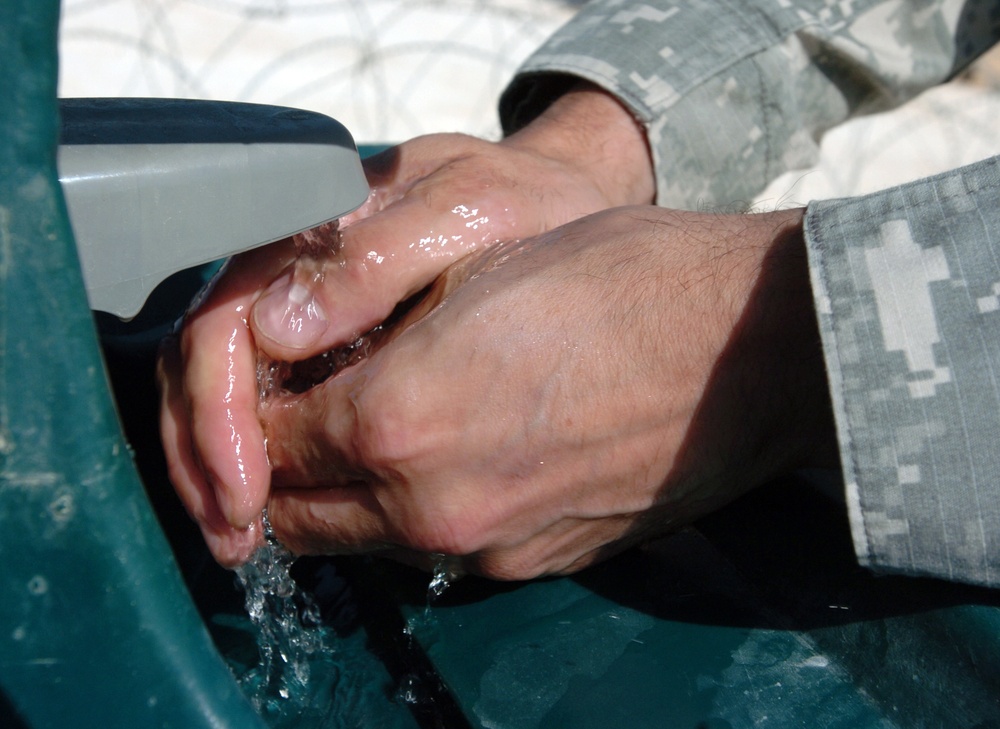
The likelihood of 42nd Division Soldiers confronting this threat is small and can be further reduced through aggressive sanitation and personal hygiene techniques.
"Just washing your hands frequently, but especially before meals will go far in reducing any threat our Soldiers face here in Egypt," Struys said.
| Date Taken: |
11.15.2007 |
| Date Posted: |
11.15.2007 13:54 |
| Story ID: |
13935 |
| Location: |
|
| Web Views: |
700 |
| Downloads: |
649 |
PUBLIC DOMAIN

This work, Guard Soldiers protect against unseen enemy, must comply with the restrictions shown on https://www.dvidshub.net/about/copyright.