
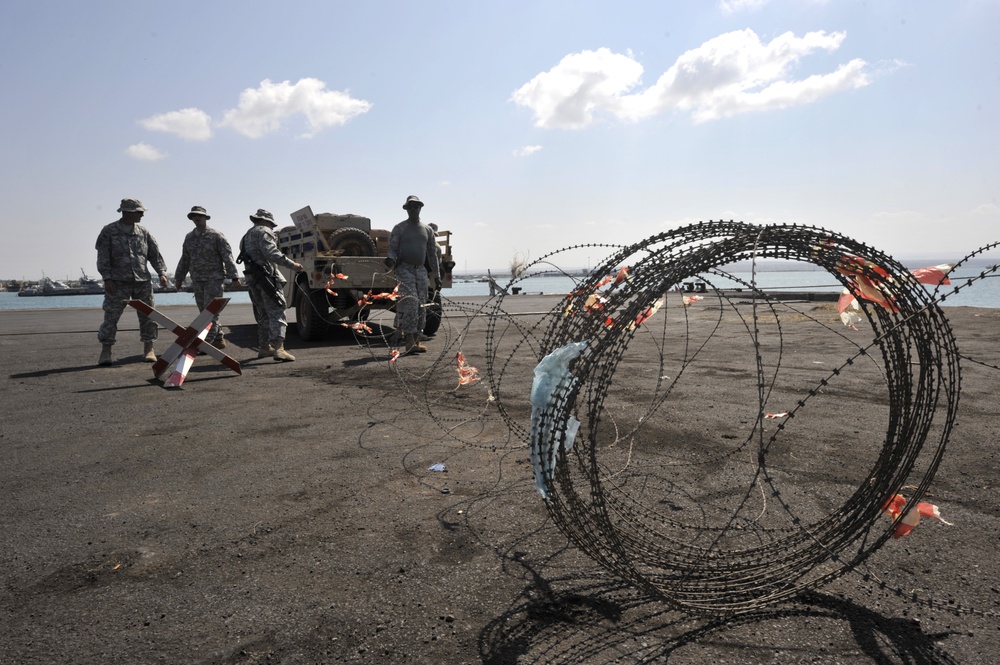
Photo By Chief Petty Officer Larry Foos | U.S. Army members of the 1/65th Infantry Battalion, Charlie Company, assigned to Camp...... read more read more
 Subscribe
CAMP LEMONNIER, Djibouti - While on convoy patrol one day in late October, U.S. Army Sgt. Hipolito Nieves noticed a wet spot on the ground on Hill 63, a checkpoint outside Camp Lemonnier. He called over his convoy commander who confirmed that someone was just there and likely fled upon their approach. They searched the area and found no one. The commander called it a defensive posture, one of many patrols conducted around the perimeter of Camp Lemonnier.
This is a snapshot of life for the U.S. Army's 1-65th Infantry Battalion, Charlie Company, also known as the Borinqueneers. As the security force for Combined Joint Tasked Force — Horn of Africa and Camp Lemonnier, Djibouti, Charlie Company carries the weapons to protect the camp. It also operates the entry control checkpoints, protects U.S. and allied ships at the massive Djibouti Port, and guards the U.S. Embassy here. The 65th is the U.S. Army National Guard from Puerto Rico, carrying with them 110 years of U.S. military history dating back to 1899, after the end of the Spanish-American War.
"Charlie Company is very proud of their unit and the job they do," said Capt. Jay A. Escobales, company commander. "They understand the history and have a real commitment for this deployment. Their performance is superb on every mission."
With commendations that include recognition for meritorious and decorated service in both World Wars and the Korean War, and the distinction of carrying out the last recorded U.S. Army battalion-sized bayonet charge (on Feb. 2, 1951), the 65th Infantry is now taking part in the current war on terrorism, and is the first full-staff Puerto Rican unit assigned to the Horn of Africa.
"My Soldiers have the expertise for this type of mission. They just completed a 14-month deployment in Guantanamo Bay (Cuba)," said Escobales. "Our primary mission is to provide camp safety and security, so the commanders can perform their intent without incident.
Although CJTF-HOA's counterterrorism policy is a non-kinetic approach through diplomacy, development and defense, the command is dependent on Charlie Company to maintain force protection in a highly volatile region. Terror extremists have made themselves known in this most unstable part of Africa, and Somalia's border is less than 10 miles from Camp Lemonnier.
"We're letting them get the feel we're enforcing here," said Nieves, convoy patrol infantry commander, commenting on potential enemies outside the gate. "We have several checkpoints around the camp, and adjust our routes and times."
According to Nieves, the convoy team is accompanied by an interpreter and Djiboutian Army personnel to ensure bilateral, host-nation support, and to eliminate unnecessary force. If a convoy team finds someone or something suspicious, they have procedures to catalogue information for future reference.
On the same patrol where evidence was found on Hill 63, a team member reported someone videotaping their convoy from the roadside. Normally, a convoy will not return back the way it came. But on this patrol, they do to look for the person with the camera. It's just another reminder of how Camp Lemonnier is often under surveillance, either for good or bad.
"We're saying to the potential enemy, 'we're protecting the base,'" says Escobales, referring to the outside-the-fence patrols. "These Soldiers are our sensors out there. Their mission is to prevent and detect any enemy activity around the base and, at the same time, show the locals that we are here to protect."
Charlie Company will be deployed at Camp Lemonnier for one year. The guardsmen and —women here are primarily from the Southern portion of the Caribbean territory. For more information about the history of the 1/65th Battalion, visit the Web site www.borinqueneers.com.
| Date Taken: | 11.06.2009 |
| Date Posted: | 11.06.2009 08:00 |
| Story ID: | 41185 |
| Location: | CAMP LEMONNIER, DJ |
| Web Views: | 1,578 |
| Downloads: | 791 |

This work, Puerto Rico's 1/65th Army Borinqueneers Takes Over Security in Horn of Africa, by CPO Larry Foos, identified by DVIDS, must comply with the restrictions shown on https://www.dvidshub.net/about/copyright.


No keywords found.




LEAVE A COMMENT