By Lance Cpl. Richard Blumenstein
III Marine Expeditionary Force Public Affairs
CENTRAL TRAINING AREA, OKINAWA, Japan — To prepare for humanitarian missions, 3rd Marine Division's Headquarters Battalion and division staff conducted a command post exercise as part of Exercise Caltrop in the Central Training Area's Landing Zone Falcon April 21-24.
Caltrop is a 3rd MarDiv exercise designed to maintain combat readiness and prepare for humanitarian assistance operations, according to Lt. Col. Michael O. Hixson, the assistant plans officer for 3rd Mar. Div.
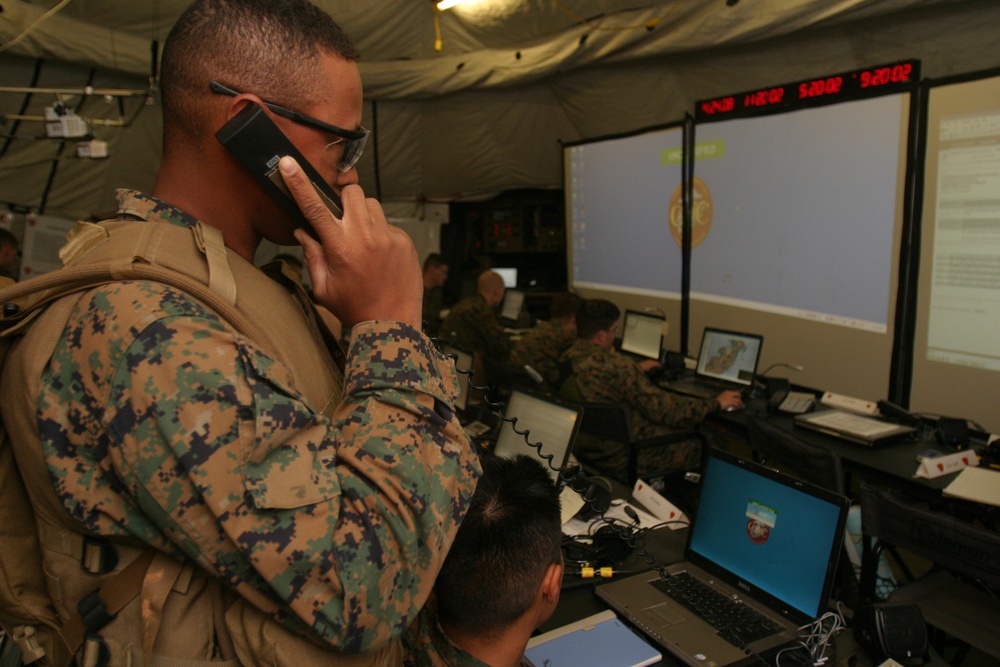
During the training, Marines set up a command post and ran a command and control center designed to coordinate military assets and develop disaster relief missions in response to scenarios created by III MEF's Tactical Exercise Control Group.
The overall scenario created by the group was a volcanic eruption on a Pacific island nation that resulted in the displacement of more than 150,000 civilians.
"Right now, that would be the most likely scenario in which the division staff would be employed," Hixson said, referencing the multiple humanitarian missions III MEF has conducted in recent years.
Division staff members ran the command post's command center as a simulated joint task force headquarters and planned missions including search and rescue, food and water transport and medical assistance, incorporating all available assets.
"Large training evolutions like this greatly improve Headquarters Battalion's ability to prepare the logistics for (real world) operations," said Gunnery Sgt. James P. Hochschild, the mess chief for Headquarters Battalion.
The Marines practiced coordinating their missions with outside units and services by communicating with units here in Okinawa and back in the United States, Hixson said.
"We want to make sure we can communicate from any distance," Hixson said. "If we can talk to someone in the states across the ocean, then we would most likely be able to talk to one of our units 100 miles away.
"If an actual humanitarian disaster occurred, we would be prepared to provide humanitarian assistance. That's what we're training for," Hixson concluded.
| Date Taken: |
05.01.2008 |
| Date Posted: |
05.01.2008 02:30 |
| Story ID: |
18978 |
| Location: |
|
| Web Views: |
420 |
| Downloads: |
309 |
PUBLIC DOMAIN

This work, 3rd MarDiv plans for contingencies in Asia-Pacific region, by Richard Blumenstein, identified by DVIDS, must comply with the restrictions shown on https://www.dvidshub.net/about/copyright.

 Subscribe





